
Force
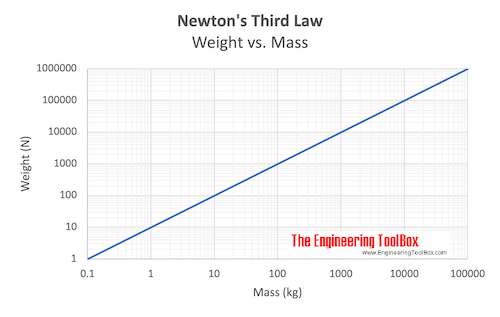
Newton's third law - force vs. mass and acceleration.
Force is an abstraction representing the push and pull interaction between objects.
The unit of force is the Newton (N) - where one newton is one kilogram metre per second squared . The Newton is defined as the force which, when applied to a mass of one kilogram , gives an acceleration of one meter per second squared .
F = m a (1)
where
F = force (N, lbf )
a = acceleration (m/s 2 , ft/s2) )
It is common to express forces as vectors with magnitude, direction and point of application. The net effect of two or more forces acting on the same point is the vector sum of the forces.
- 1 N = (1 kg) (1 m/s2)
- A Newton is the unbalanced force which will give a 1 kg mass an acceleration of 1 m/s2.
In the centimetre–gram–second system of units (cgs) - a variant of the metric system - the unit of force is called the dyne.
- 1 N = 100000 dyne
- A dyne is the unbalanced force which will give a 1 gram mass an acceleration of 1 cm/s2.
The unit of force in the Imperial or British system is the pound - lb, lbf .
- 1 lbf = 4.45 N
- A pound is the unbalanced force which will give a 1 slug mass an acceleration of 1 ft/s2.
Newton's Third Law
Newton's third law describes the forces acting on objects interacting with each other. Newton's third law can be expressed as
- "If one object exerts a force F on an other object, then the second object exerts an equal but opposite force F on the first object"
Body Force
A body force is when one body exerts a force on an other body without direct physical contact between the bodies. Examples - gravitation or electromagnetic fields .
Support Reactions
Surface forces at supports or points of contact between bodies are called reactions .
Acceleration
If there is a net unbalance between forces acting on a body the body accelerates. If the forces are balanced the body will not accelerate.
Example - Force and Acceleration
A mass of 50 kg is accelerated with 2 m/s 2. The force required can be calculated as
F = (50 kg) (2 m/s 2 )
= 100 N
Example - Force due to Gravity (Weight)
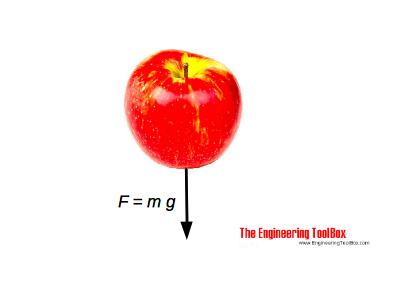
The gravity force - weight - on a apple with mass 50 g (0.050 kg) due to acceleration of gravity a g = 9.81 m/s2 - can be calculated as
F = (0.050 kg) (9.81 m/s2)
= 0.4905 N
Acceleration of Gravity on Earth
- SI units: a g = 9.81 m/s2
- Imperial units: a g = 32.174 ft/s2
- more about mass and weight
Force Calculator
The calculator below can used to calculate force due to mass and acceleration:
Example - Hoisting a Body
A body with mass m = 60 kg is hoisted by a winch. The force in the hoisting cable is F c = 700 N. The gravity force weight - W - pulling the body downwards due to the gravity - can be calculated as
W = m a g
= (60 kg) (9.81 m/s2)
= 588.6 N
= 0.59 kN
The resulting acceleration force - F a - which moves the body upwards - can be calculated by subtracting the weight of the body from the cable force as
F a = (700 N) - (588.6 N)
= 111.4 N
= 0.11 kN
The acceleration of the body can be calculated as
a = F a / m
= (111.4 N) / (60 kg)
= 1.86 m/s2
Related Topics
-
Beams and Columns
Deflection and stress in beams and columns, moment of inertia, section modulus and technical information. -
Dynamics
Motion of bodies and the action of forces in producing or changing their motion - velocity and acceleration, forces and torque. -
Mechanics
The relationships between forces, acceleration, displacement, vectors, motion, momentum, energy of objects and more. -
Statics
Forces acting on bodies at rest under equilibrium conditions - loads, forces and torque, beams and columns.
Related Documents
-
Acceleration
Change in velocity vs. time used. -
Acceleration of Gravity and Newton's Second Law
Acceleration of gravity and Newton's Second Law - SI and Imperial units. -
Acceleration Units Converter
Converting between units of acceleration. -
Bodies Moving on Inclined Planes - Acting Forces
Required forces to move bodies up inclined planes. -
Bollard Forces
Friction, load and effort forces acting in ropes turned around bollards. -
Center Mass
Calculate position of center mass. -
Center of Gravity
A body and the center of gravity. -
Centripetal and Centrifugal Acceleration Force
Forces due to circular motion and centripetal / centrifugal acceleration. -
Disk Brakes - Torque and Force
Forces and torque activated with disk brakes. -
Equilibrant Force
The force required to keep a system of forces in equilibrium. -
Force Ratio
The force ratio is the load force versus the effort force. -
Forces and Tensions in Ropes due to Angle
Reduced load capacities in ropes, cables or lines - due to acting angle. -
Gears
Gears effort force vs. load force. -
Hot Air Balloons - Calculate Lifting Weights
Calculate hot air ballons lifting forces. -
Impact Force
Impact forces acting on falling objects hitting the ground, cars crashing and similar cases. -
Jet Propulsion
Calculate the propulsive discharge force or thrust induced by an incompressible jet flow. -
Levers
Use levers to magnify forces. -
Lifting Wheels
Loads and effort force with lifting wheels. -
Mass vs. Weight
Mass vs. weight - the Gravity Force. -
Shackles - Safe Loads
Safe loads of shackles. -
Support Reactions - Equilibrium
Static equilibrium is achieved when the resultant force and resultant moment equals to zero. -
Threaded Rods - Proof Loads - Metric Units
Proof load capacities of metric threaded steel rods. -
Toggle Joint
A toggle joint mechanism can be used to multiply force. -
Vector Addition
Online vector calculator - add vectors with different magnitude and direction - like forces, velocities and more. -
Winches
Effort force to raise a load. -
Wind Load vs. Wind Speed
Wind load on surface - Wind load calculator. -
Work done by Force
Work done by a force acting on an object.



