
Work done by Force
Work done by a force acting on an object.
When a body is moved as a result of a force being applied to it - work is done .
Work done by a Constant Force
The amount of work done by a constant force can be expressed as
W F = F s (1)
where
W F = work done (J, ft lbf )
F = constant force acting on object (N, lbf )
s = distance object is moved in direction of force (m, ft)
The unit of work in SI units is joule (J) which is defined as the amount of work done when a force of 1 Newton acts for distance of 1 m in the direction of the force.
- 1 J (Joule) = 0.1020 kpm = 2.778x10 -7 kWh = 2.389x10⁻⁴ kcal = 0.7376 ft lbf = 1 (kg m2)/s2= 1 watt second = 1 Nm = 1 ft lb = 9.478x10⁻⁴ Btu
- 1 ft lbf (foot pound force) = 1.3558 J = 0.1383 kp m = 3.766x10 -7 kWh = 3.238x10⁻⁴ kcal = 1.285x10⁻³ Btu
This is the same unit as energy .
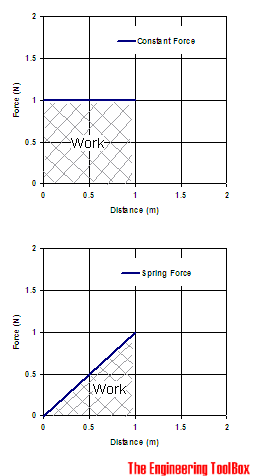
The work done by a constant force is visualized in the chart above. The work is the product force x distance and represented by the area as indicated in the chart.
Example - Constant Force and Work
A constant force of 20 N is acting a distance of 30 m . The work done can be calculated as
W F = (20 N) (30 m)
= 600 (J, Nm)
Example - Work done when lifting a Brick of mass 2 kg a height of 20 m above ground
The force acting on the brick is the weight and the work can be calculated as
W F = F s
= m a g s (2)
= (2 kg) (9.81 m/s2) (20 m)
= 392 (J, Nm)
Example - Work when Climbing Stair - Imperial units
The work made by a person of 150 lb climbing a stair of 100 ft can be calculated as
W F = (150 lb) (100 ft)
= 15000 ft lb
Work done by a Spring Force
The force exerted by springs varies with the extension or compression of the spring and can be expressed with Hooke's Law as
F spring = - k s (3)
where
F spring = spring force (N, lbf )
k = spring constant
The work done by a spring force is visualized in the chart above. The force is zero with no extension or compression and the work is the half the product force x distance and represented by the area as indicated. The work done when a spring is compressed or stretched can be expressed as
W spring = 1/2 F spring_max s
= 1/2 k s2(4)
where
W spring < = work done (J, ft lbf )
F spring_max = maximum spring force (N, lbf )
Example - Spring Force and Work
A spring is extended 1 m . The spring force is variable - from 0 N to 1 N as indicated in the figure above - and the work done can be calculated as
W spring = 1/2 (1 N/m) (1 m)2
= 0.5 (J, Nm)
The spring constant can be calculated by modifying eq. 4 to
k = 2 (0.5 J)/ (1 m)2
= 1 N/m
Work done by Moment and Rotational Displacement
Rotational work can be calculated as
W M = T θ (5)
where
W M = rotational work done (J, ft lb)
T = torque or moment (Nm, ft lb)
θ = displacement angle ( radians )
Example - Rotational Work
A machine shaft acts with moment 300 Nm . The work done per revolution (2 π radians ) can be calculated as
W M = (300 Nm) ( 2 π )
= 1884 J
Representations of Work
Force can be exerted by weight or pressure:
W = ∫ F ds
= ∫ m a g dh
=∫ p A ds
=∫ p dV (6)
where
W = work (J, Nm)
F = force (N)
ds = distance moved for acting force, or acting pressure (m)
m = mass (kg)
a g = acceleration of gravity (m/s2)
dh = elevation for acting gravity (m)
p = pressure on a surface A, or in a volume (Pa, N/m2)
A = surface for acting pressure (m2)
dV = change in volume for acting pressure p (m3 )
Power vs. Work
Power is the ratio of work done to used time - or work done per unit time.
Related Topics
-
Dynamics
Motion of bodies and the action of forces in producing or changing their motion - velocity and acceleration, forces and torque. -
Mechanics
The relationships between forces, acceleration, displacement, vectors, motion, momentum, energy of objects and more. -
Thermodynamics
Work, heat and energy systems.
Related Documents
-
1st Law of Thermodynamics
The First Law of Thermodynamics simply states that energy can be neither created nor destroyed (conservation of energy). Thus power generation processes and energy sources actually involve conversion of energy from one form to another, rather than creation of energy from nothing. -
Bodies Moving on Inclined Planes - Acting Forces
Required forces to move bodies up inclined planes. -
Energy
Energy is the capacity to do work. -
Force
Newton's third law - force vs. mass and acceleration. -
Heat, Work and Energy
Heat vs. work vs. energy. -
Impact Force
Impact forces acting on falling objects hitting the ground, cars crashing and similar cases. -
Potential Energy - Hydropower
Elevation and potential energy in hydropower. -
Power
Power is the rate at which work is done or energy converted. -
Pump Power Calculator
Calculate pumps hydraulic and shaft power. -
Staircases Calculator
Calculate steps, unit rise and run in a staircase. -
Torque - Work done and Power Transmitted
The work done and power transmitted by a constant torque. -
Turbo Machines - Specific Work done by Pumps, Compressors or Fans
Calculate specific work done by pumps, fans, compressors or turbines.



