
Bollard Forces
Friction, load and effort forces acting in ropes turned around bollards.
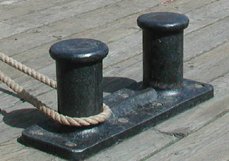
Bollards are common on quays and used to moore ships and boats. By turning a rope around a pole the effort force required to hold the load force can be reduced dramatically.
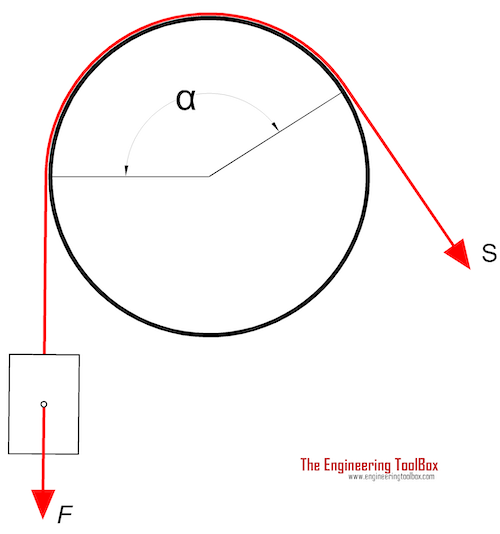
The effort force in a rope around a bollard can be calculated as
S = F e -(μ α rad ) (1)
where
S = effort force in the rope (N, lb)
F = load force (N, lbf )
e = 2.718..
μ = friction coefficient (approximately 0.3 - 0.5 is common for a rope around a steel or cast iron bollard)
α rad = 2 π α degrees / 360 = angle where the rope is in contact with the bollard ( radians )
α degrees = angle where the rope is in contact with the bollard (degrees)
Angle - turns, degrees and radians
- 1/4 turn : 90 degrees => α = 1/2 π
- 1/2 turn : 180 degrees => α = π
- 1 turn : 360 degrees => α = 2 π
- 2 turns : 720 degrees => α = 4 π
Example - A rope with One turn around a Bollard
One turn equals to 360 degrees or 2 π radians. With a friction coefficient of 0.5 the effort force in the rope can be calculated as
S = F e -(0.5 2 π)
= 0.043 F (N)
One turn around the bollard reduces the required effort force to less than 5% of the load force.
Example - Shoring a ship
The retardation (negative acceleration ) of a ship arriving at quay with velocity 0.05 m/s and stopped within 2 seconds - can be calculated as
a = dv/dt (2)
= (0.05 m/s) / (2 s)
= 0.025 (m/s2)
With ship mass 20000 kg the required force in the rope from the ship (load) can be calculated as
F = m a (3)
= (20000 kg) (0.025 m/s2)
= 500 N
= 0.5 kN
The required effort force in the rope with a half turn around the bollard ( 180 degrees or π radians) with a friction coefficient of 0.4 can be calculated as
S = (500 N) e -0.4 π
= 142 N
= 0.14 kN
The Effort Force - Load Force ratio for various rope angles are indicated in the chart below:
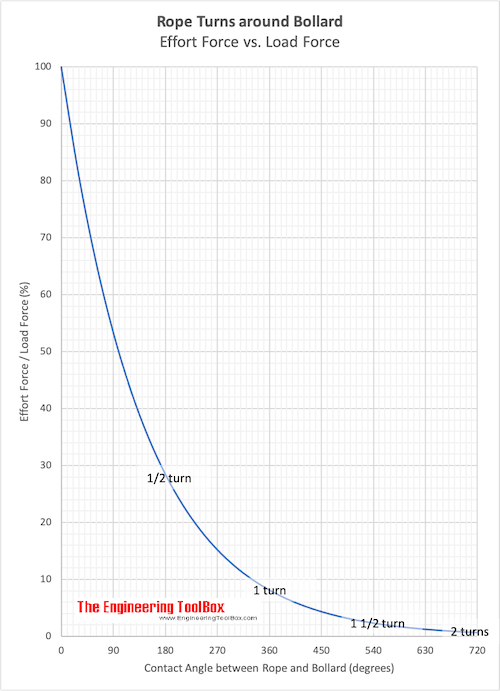
Download and print Rope Turns around Bollard Effort Force vs. Load Force Chart
- friction coefficient 0.5
Bollard (or Pole) Effort Force Calculator
This calculator is based on the equation above and can be used to calculate the effort force in ropes turned around poles or bollards. Note that the calculator uses degrees for the turns.
Related Topics
-
Dynamics
Motion of bodies and the action of forces in producing or changing their motion - velocity and acceleration, forces and torque. -
Mechanics
The relationships between forces, acceleration, displacement, vectors, motion, momentum, energy of objects and more. -
Statics
Forces acting on bodies at rest under equilibrium conditions - loads, forces and torque, beams and columns.
Related Documents
-
Equilibrant Force
The force required to keep a system of forces in equilibrium. -
Force
Newton's third law - force vs. mass and acceleration. -
Forces and Tensions in Ropes due to Angle
Reduced load capacities in ropes, cables or lines - due to acting angle. -
Friction - Friction Coefficients and Calculator
Friction theory with calculator and friction coefficients for combinations of materials like ice, aluminum, steel, graphite and many more. -
Impact Force
Impact forces acting on falling objects hitting the ground, cars crashing and similar cases. -
Manila Ropes - Strength
Minimum breaking strength and safe load of manila 3-strand rope. -
Mass vs. Weight
Mass vs. weight - the Gravity Force. -
Nylon Ropes - Strengths
Nylon 3-strand and 8-strand rope - minimum breaking strength and safe load. -
Polyester Polyolefin Ropes - Strengths
Polyester Polyolefin dual fiber 3-strand rope - minimum breaking strength and safe load. -
Polyester Ropes - Strengths
Polyester 3-strand and 8-strand rope - minimum breaking strength and safe load. -
Polypropylene Fiber Ropes - Strengths
Polypropylene fiber 3-strand and 8 strand rope - minimum breaking strength and safe load. -
Shackles - Safe Loads
Safe loads of shackles. -
Shipping Measuring Units
Vessel and cargo capacities. -
Vector Addition
Online vector calculator - add vectors with different magnitude and direction - like forces, velocities and more. -
Wire Rope Slings
Sling angles and influence on capacity.



