
Centripetal and Centrifugal Acceleration Force
Forces due to circular motion and centripetal / centrifugal acceleration.
Centripetal and Centrifugal Force are the action-reaction force pair associated with circular motion.
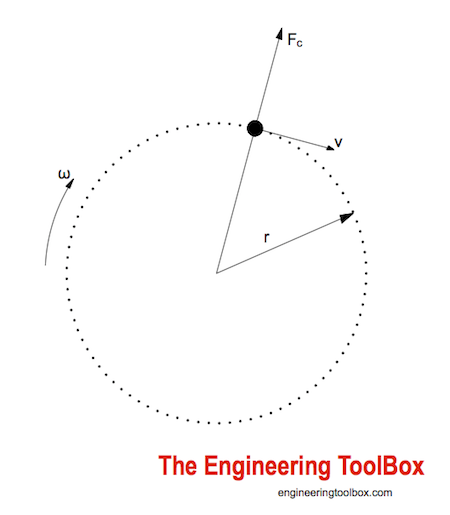
Centripetal Acceleration
Velocity is a vector - specifying how fast (or slow) a distance is covered and the direction of the movement. Since the velocity vector (the direction) of a body changes when moved in a circle - there is an acceleration.
This acceleration is named the centripetal acceleration - and can be expressed as
a c = v2/ r
= ω2r
= (2 π n rps )2r
= (2 π n rpm / 60)2r
(π n rpm / 30)2r (1)
where
a c = centripetal acceleration (m/s2, ft/s2 )
v = tangential velocity (m/s, ft/s)
r = circular radius (m, ft)
ω = angular velocity ( rad /s)
n rps = revolutions per second (rev/s, 1/s)
n rpm = revolutions per min (rev/min, 1/min)
Centripetal Force
According Newton's second law the centripetal force can be expressed as
F c = m a c
= m v2/ r
= m ω2r
= m (2 π n s )2r
= m (2 π n rpm / 60)2r
= m (π n rpm / 30)2r (2)
where
F c = centripetal force (N, lbf )
m = mass (kg, slugs )
According to Newton's Third Law the centripetal force acting on the object has a centrifugal force of the same magnitude acting in the opposite direction.
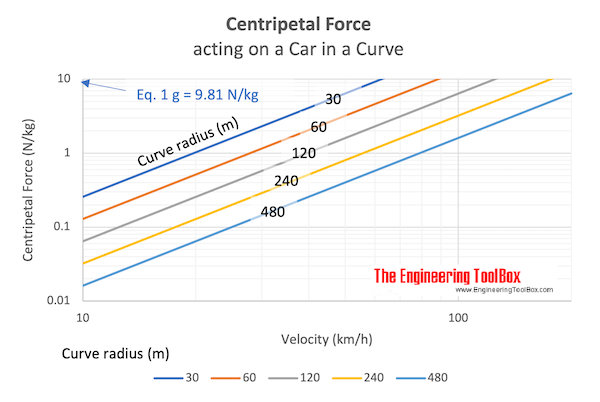
Example - the Centripetal Acceleration and Force acting on a Car through a Curve

Metric Units
A car with mass 1000 kg drives through a curve with radius 200 m at speed 50 km/h . The centripetal acceleration can be calculated as
a c = ((50 km/h) (1000 m/km) (1/3600 h/s))2/ (200 m)
= 0.965 m/s2
= 0.1 g
where
1 g = acceleration of gravity (9.81 m/s2)
The centripetal force can bee calculated as
F c = (1000 kg) ( 0.965 m/s2)
= 965 N
= 0.97 kN
Related to the gravity force - weight :
F g = (1000 kg) (9.81 m/s2)
= 9810 N
= 9.8 kN
Imperial Units
A car with weight (gravity force) 3000 lb travels through a curve with radius 100 ft with speed 15 miles/h .
The mass of the car can be calculated as
m = (3000 lb) / (32 ft/s2)
= 94 slugs
The centripetal acceleration can be calculated as
a c = ((15 miles/h)(5280 ft/mile) / (3600 s/h))2/ (100 ft)
= 4.84 ft/s2
The centripetal force can bee calculated as
F c = (94 slugs) (4.84 ft/s2)
= 455 lbf
Centripetal (Centrifugal) Calculator - velocity
This calculator can be used if the velocity of an object is known - like a car in a turning curve.
Centripetal (Centrifugal) Force - rpm
Equation (2) can be modified to express centripetal or centrifugal force as a function of revolution per minute - rpm - as
F c = 0.01097 m r n rpm 2(3)
where
n rpm = revolution per minute (rpm)
Centripetal (Centrifugal) Calculator - rpm
This calculator can be used if revolution speed of an object is known - like a turning bowl in a lathe.
Centrifugal Force
Force is an abstraction representing the push and pull interaction between objects. Newton's third law states that
- for every acting force there is an equal and opposite reaction force
Therefore there must be an equal and opposite reaction force to the Centripetal Force - the Centrifugal Force.
Related Topics
-
Dynamics
Motion of bodies and the action of forces in producing or changing their motion - velocity and acceleration, forces and torque. -
Mechanics
The relationships between forces, acceleration, displacement, vectors, motion, momentum, energy of objects and more.
Related Documents
-
Acceleration
Change in velocity vs. time used. -
Acceleration of Gravity and Newton's Second Law
Acceleration of gravity and Newton's Second Law - SI and Imperial units. -
Acceleration Units Converter
Converting between units of acceleration. -
Banked Turn
A turn or change of direction in which the vehicle banks or inclines, usually towards the inside of the turn. -
Car - Required Power and Torque
Power, torque, efficiency and wheel force acting on a car. -
Car Acceleration
Car acceleration calculator. -
Car Fuel Consumption - liter/100 km
Calculate fuel consumption in liter per km - consumption chart and calculator. -
Cars - New vs. Old Car Cost Calculator
Calculate and compare the costs between owning a new vs. an old car. -
Conn-Rod Mechanism
The connecting rod mechanism. -
Conservation of Momentum
The momentum of a body is the product of its mass and velocity - recoil calculator. -
Distance Traveled vs. Speed and Time - Calculator and Chart
Velocity plotted in time used diagram. -
Driving Distances between European Cities
Driving distance between some major European cities. -
Equilibrant Force
The force required to keep a system of forces in equilibrium. -
Force
Newton's third law - force vs. mass and acceleration. -
Force Ratio
The force ratio is the load force versus the effort force. -
Formulas of Motion - Linear and Circular
Linear and angular (rotation) acceleration, velocity, speed and distance. -
Fuel Consumption - mpg
Calculate fuel consumption in miles per gallon - mpg - calculator and consumption charts. -
Piston Engines - Compression Ratios
Cylinder volume and compression ratios in piston engines. -
Projectile Range
Calculate the range of a projectile - a motion in two dimensions. -
Rolling Resistance
Rolling friction and rolling resistance. -
Rotating Bodies - Stress
Stress in rotating disc and ring bodies. -
Torque or Moment of Force - Online Converter
Torque or moment - the tendency of a force to rotate an object. -
Vehicle - Distance Traveled vs. Velcocity and Time Used (mph)
Speed (mph) and time (hours) and distance traveled (miles) chart. -
Vehicle - Distance Traveled vs. Velocity and Time (km/h)
Speed (km/h) vs. time (hours) and distance traveled (km). -
Vehicles Traffic Flow and Density
Traffic flow and density as used in highway design.



