
Types of Fans - Capacity Ranges
Centrifugal, axial and propeller fans and their capacity ranges.
Common types of fans and their characteristics are summarized in the table below:
| Fan Type | Wheel Type | Static Pressure (in H2O) | Wheel Diameter (in) | Air Flow (cfm) | Brake Horse Power (bhp) |
|---|---|---|---|---|---|
| Centrifugal | Backward Inclined | 0 - 12 | 10 - 75 | 500 - 125000 | 0.33 - 200 |
| Backward Inclined Airfoil | 0 - 14 | 20 - 120 | 1500 - 450000 | 0.33 - 1500 | |
| Propeller Axial | Direct Drive | 0 - 1 | 10 - 50 | 50 - 50000 | 0.17 - 10 |
| Tube Axial | Direct Drive | 0 - 1 | 20 - 50 | 2500 - 50000 | 0.33 - 15 |
| Tubular Centrifugal | Backward Inclined | 0 - 10 | 10 - 110 | 500 - 350000 | 0.33 - 750 |
| Vane Axial | Direct Drive | 0 - 5 | 20 - 60 | 1200 - 150000 | 0.33 - 150 |
- Centrifugal - flow within the fan is mainly radial to the shaft
- Axial - flow within the fan is mainly parallel to the shaft
Brake horsepower is the actual power delivered to or by a shaft.
Centrifugal Fans
The centrifugal fans operates by throwing air away from the blade tips. The blade wheel are mounted in housing and the blades can be forward curved, straight, or backward curved.
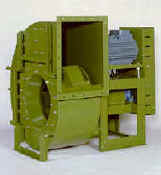
Backward curved blades are generally more efficient and non-overloading.
The centrifugal fans are preferred before axial fans where high airflow rates and high static pressures are required.
Axial Fans
Tube-axial fans consists of propeller-shaped blades and a drive motors mounted in tubes. The fans are in general build to be implemented in the duct work.
Vane-axial fans are variations of the tube-axial fans with air straightening vanes added in front of or behind the propeller blades.
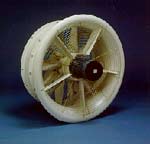
A propeller-axial fan consists of a a propeller-shaped blade and a drive motor mounted on a flat frame. The construction is often build to be installed in a wall or located individually in the room.
Related Topics
-
Ventilation Systems
Design of systems for ventilation and air handling - air change rates, ducts and pressure drops, charts and diagrams and more.
Related Documents
-
Fan Affinity Laws
The affinity laws can be used to calculate resulting volume capacity, head or power consumption when speed or wheel diameters are changed. -
Fan Capacity Diagrams
Pressure, head, air flow volume and fan capacity diagrams. -
Fans - Calculate Air and Brake Horsepower
AHP - Air Horse Power and BHP - Brake Horse Power. -
Pumps vs. Compressors, Blowers and Fans
The difference between pumps, compressors, blowers and fans. -
Pumps, Fans and Turbines - Horsepower
British Horse Power as used for pumps, fans and turbines - and how to convert to other units. -
Static Pressure vs. Head
Static pressure vs. pressure head in fluids. -
Types of Fans
Axial and propeller fans, centrifugal (radial) fans, mixed flow fans and cross flow fans.



