
Pumps, Fans and Turbines - Horsepower
British Horse Power as used for pumps, fans and turbines - and how to convert to other units.
Horsepower
Horsepower is the imperial (British) unit of power. A horsepower is the ability to do work at the rate of
- 33000 ft.lb per min or
- 550 ft.lb per second
Note that Power is "Work per unit time" and work is "Force through distance". In gravity systems the Force is Weight - mass multiplied with gravity.
In the SI system the unit of power is watt (W, Nm/s, J/s).
The total horsepower developed by water falling from a given height is the product of the mass flow rate in pounds per minute times the falling height in feet divided by 33000 and can be expressed as:
Php = mmin h ag / 33000 (1)
where
Php = power (horsepower, hp)
mmin = mass flow rate per minute (lbm/min)
h = head or height (ft)
ag = acceleration of gravity (32 ft/s2)
(1) can alternatively be expressed as:
Php = msec h ag / 550 (1b)
where
msec = mass flow rate per second (lbm/s)
(1) can also be expressed as:
Php = γ Q h / 33000 (1c)
where
Q = volume flow rate (ft3/min)
γ= specific weight (lbf/ft3) (weight is force)
Water Horsepower for Flow in gal/min
Water horsepower for flow in gal/min can be expressed as:
Pwhp = SG Qgal h / 3960 (1d)
where
Q = volume flow rate (gpm)
SG= specific gravity
h = head (ft)
SG for water is 1.001 at 32oF and 0.948 at 240oF.
Power to Pump Water
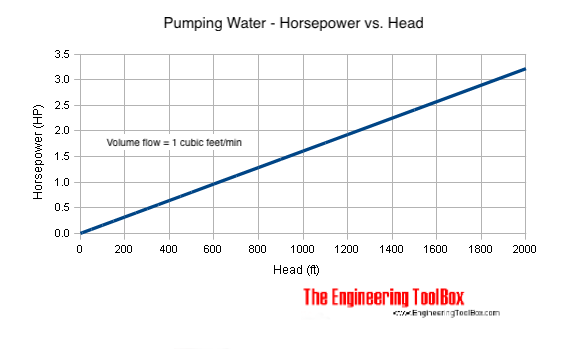
Required horsepower (hp) to pump 1 cubic foot of water per minute (ft3/min) with efficiency 85% - is indicated in the diagram below:
- 1 hp (English horse power) = 745.7 W
- 1 ft (foot) = 0.3048 m
Example - Required Power to lift 10 ft3/min of Water 600 ft
According the diagram above 1 hp is required to lift 1 ft3/min of water 600 ft. Required power to pump 10 ft3/min can be calculated as
(10 ft3/min) (1 hp) / (1 ft3/min) = 10 hp
Shaft or Brake Horsepower
The brake horsepower is the amount of real horsepower going to the pump, not the horsepower used by the motor. In the metric system kilowatts (kW) is used.
Due to hydraulic, mechanical and volumetric losses in a pump or turbine the actual horsepower available for work on or from the fluid is less than the total horsepower supplied.
Shaft or Brake Horsepower for a Pump or Fan
The brake horse power - bhp - for a pump or fan can be expressed as:
Pbhp = ( γ Q h / 33000 ) / η (2)
where
Pbhp = brake horse power (horsepower, hp)
Q = volume flow rate (ft3/min, cfm)
Shaft or Brake Horsepower for a Turbine
The brake horse power - bhp - for a turbine can be expressed as:
Pbhp = η ( γ Q h / 33000 ) (2b)
Input Horsepower to the Electrical Motor
The input horsepower to the electrical motor for a pump or fan can be expressed as:
Php_el = Pbhp /ηe (3)
or
Php_el = (m h g / 33000) / (ηηe) (3b)
where
Php_el = input power to the electrical motor
ηe = mechanical efficiency of the electrical motor
Horsepower in Kilowatts and other Units
Horsepower can be converted to other common units as:
- 1 hp (English horse power) = 745.7 W = 0.746 kW = 550 ft.lb/s = 2545 Btu/h = 33000 ft.lb/m = 1.0139 metric horse power
Transforming horsepower to kW:
PkW = 0.746 Php (4)
where
PkW = power (kW)
Together with the equations above it's possible to express (4) in many common combinations - such as:
PkW = 0.746 (m h / 33000) / η ηe (5)
Example - Pump Power
The horsepower required to pump 50 lbm/min water a head of 10 ft with a pump with overall efficiency 0.7 - can be calculated with eq. (3) as
Php = ((50 lbm/min)(10 ft) (32 ft/s2) / 33000) / 0.8
= 0.6 hp
The power in kW can be calculated as
PkW = 0.746 (0.6 hp)
= 0.45 kW
Related Topics
-
Basics
Basic engineering data. SI-system, unit converters, physical constants, drawing scales and more. -
Pumps
Design of pumping systems and pipelines. With centrifugal pumps, displacement pumps, cavitation, fluid viscosity, head and pressure, power consumption and more.
Related Documents
-
Boiler Horsepower
Boiler horsepower vs. heat transfer area. -
Centrifugal Pumps - Viscosity Influence
Hydrodynamic losses through pumps depends on fluid viscosities. -
Density vs. Specific Weight and Specific Gravity
An introduction to density, specific weight and specific gravity. -
Electrical Motors - Shaft Power vs. Voltage and Current
Calculate electric motors shaft power. -
Fan AMCA Classification
Fan classification established by AMCA. -
Fans - Efficiency and Power Consumption
Power consumption and typical efficiencies of fans -
Hydropower
Power potential vs. head and flow rate. -
Positive Displacement Pumps
Introduction tutorial to positive displacement pumps basic operating principles. -
Potential Energy - Hydropower
Elevation and potential energy in hydropower. -
Power
Power is the rate at which work is done or energy converted. -
Power Gained by Fluid from Pump or Fan
Calculate the power gained by fluid from an operating pump or fan. -
Pump - Temperature Rise vs. Volume Flow
Calculate temperature rise vs. volume flow in pumps. -
Pump Power Calculator
Calculate pumps hydraulic and shaft power. -
Pumping Water - Required Horsepower
Horsepower required to pump water. -
Pumps - Specific Speed
Characterizing of impeller types in pumps in a unique and coherent manner. -
Types of Fans - Capacity Ranges
Centrifugal, axial and propeller fans and their capacity ranges.



