
U-Tube Differential Pressure Manometers
Inclined and vertical u-tube manometers used to measure differential pressure in flow meters like pitot tubes, orifices and nozzles.
Pressure measuring devices using liquid columns in vertical or inclined tubes are called manometers. One of the most common is the water filled u-tube manometer used to measure pressure difference in pitot or orifices located in the airflow in air handling or ventilation system.
In the figure bellow illustrates the water levels in an u-tube where the left tube is connected to a point with higher pressure than the right tube - example: the left tube may be connected to a pressurized air duct when the right tube is open to the ambient air.
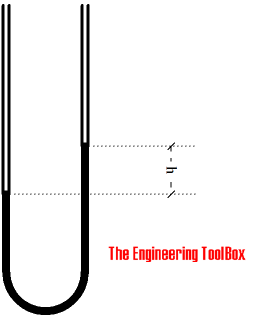
Vertical U-Tube Manometer
The pressure difference measured by a vertical U-Tube manometer can be calculated as
p d = γ h
= ρ g h (1)
where
p d = pressure (Pa, N/m2, lb/ft2)
γ = ρ g = specific weight of liquid in the tube (kN/m3, lb/ft3 )
ρ = U-tube liquid density (kg/m3, lb/ft3 )
g = acceleration of gravity (9.81 m/s2, 32.174 ft/s2)
h = liquid height (m fluid column, ft fluid column)
The specific weight of water , which is the most commonly used fluid in u-tube manometers, is 9.81 kN/m3 or 62.4 lb/ft3 .
Note! - the head unit is with reference to the density of the flowing fluid. For other units and reference liquid - like mm Water Column - check Velocity Pressure Head .
Example - Orifice Differential Pressure Measurement
A water manometer connects the upstream and downstream pressure of an orifice located in an air flow. The difference height in the water column is 10 mm .
The pressure difference head can calculated from (1) as
p d = (9.8 kN/m3 ) (103 N/kN) (10 mm) (10-3 m/mm)
= 98 (N/m2, Pa)
where
9.8 (kN/m3 ) is the specific weight of water in SI-units.
Inclined U-Tube Manometer
A common problem when measuring the pressure difference in low velocity systems - or systems with low density fluids - like air ventilation systems - are low column heights and accuracy. Accuracy can be improved by inclining the u-tube manometer.
The figure bellow indicates a u-tube where the left tube is connected to a higher pressure than the right tube. Note that the left and the right tube must in the same declined plane for the angle to the horizontal plane to be correct.
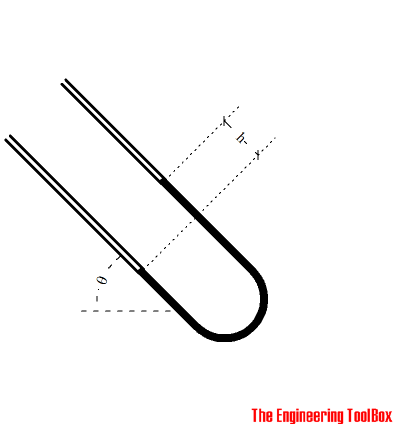
The pressure difference in a inclined u-tube manometer can be expressed as
p d = γ h sin(θ) (2)
where
h = length, difference in position of the liquid column along the tube (mm, ft)
θ = angle of column relative the horizontal plane (degrees)
Inclining the tube manometer increases the accuracy of the measurement.
Example - Differential Pressure Measurement with an Inclined U-Tube manometer
We use the same data as in the example above, except that the U-Tube is inclined 45 o .
The pressure difference head can then be expressed as:
p d = (9.8 kN/m3 ) (103 N/kN) (10 mm) (10-3 m/mm) sin(45 o )
= 69.3 N/m2(Pa)
U-tube Manometer Calculator
This calculator can be used to calculate the differential pressure measured with an U-tube manometer.
(9.8 kN/m3, 62.4 lb/ft3 default values for water)
Related Topics
-
Flow Measurements
Flow metering principles - Orifice, Venturi, Flow Nozzles, Pitot Tubes, Target, Variable Area, Positive Displacement, Turbine, Vortex, Electromagnetic, Ultrasonic Doppler, Ultrasonic Time-of-travel, Mass Coriolis, Mass Thermal, Weir V-notch, Flume Parshall and Sluice Gate flow meters and more. -
Fluid Mechanics
The study of fluids - liquids and gases. Involving velocity, pressure, density and temperature as functions of space and time. -
Ventilation Systems
Design of systems for ventilation and air handling - air change rates, ducts and pressure drops, charts and diagrams and more.
Related Documents
-
Comparing Flowmeters
A limited comparison of flowmeter principles - regarding service, rangeability, pressure loss, typical accuracy, upstream pipe diameters, viscosity and relative costs. -
Density vs. Specific Weight and Specific Gravity
An introduction to density, specific weight and specific gravity. -
Energy and Hydraulic Grade Line
The hydraulic grade line and the energy line are graphical presentations of the Bernoulli equation. -
Flowmeter - Accuracy
Introduction to accuracy in flow measurement devices. -
Flowmeters - Turndown Ratios
Turndown ratio (Rangeability) can be used to compare flow measurement devices like orifices, venturi meters etc. -
Fluid Flowmeters - Comparing Types
An introduction to the different types of fluid flowmeters - Orifices, Venturies, Nozzles, Rotameters, Pitot Tubes, Calorimetrics, Turbine, Vortex, Electromagnetic, Doppler, Ultrasonic, Thermal, Coriolis. -
Orifice, Nozzle and Venturi Flow Rate Meters
The orifice, nozzle and venturi flow rate meters makes the use of the Bernoulli Equation to calculate fluid flow rate using pressure difference through obstructions in the flow. -
Pitot Tubes
Pitot tubes can be used to measure fluid flow velocities by measuring the difference between static and dynamic pressure in the flow. -
Velocity-Area Flowmetering
Flow rate or discharge in an open conduit, channel or river can be calculated with the velocity-area principle. -
Water - Density, Specific Weight and Thermal Expansion Coefficients
Definitions, online calculator and figures and tables with water properties like density, specific weight and thermal expansion coefficient of liquid water at temperatures ranging 0 to 360°C (32 to 680°F).



