
Flowmeters - Turndown Ratios
Turndown ratio (Rangeability) can be used to compare flow measurement devices like orifices, venturi meters etc.
Turndown ratio - rangeability - is often used to compare the span - the range - of flow measurement devices.
Turndown Ratio - Rangeability
Turndown ratio can be expressed as:
TR = qmax / qmin (1)
where
TR = Turndown Ratio
qmax = maximum flow
qmin = minimum flow
Maximum and minimum flow is stated within a specified accuracy and repeatability for the device.
Example - Turndown Ratio for an Orifice Meter
The turndown ratio - TR - for an orifice meter with maximum flow of 12 kg/s and a minimum flow of 3 kg/s can be calculated as:
TR = (12 kg/s) / (3 kg/s)
= 4
- normally expressed as turndown ratio of 4:1
This is a typical turndown ratio for a orifice plate. In general a orifice plates has turndown ratio between 3:1 and 5:1.
Turndown Ratio and Measured Signal
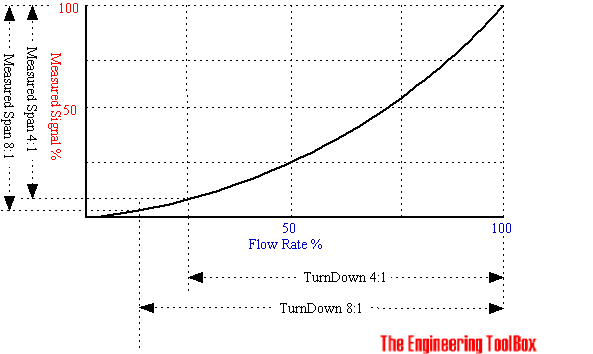
In a flow meter based on the orifice or venturi principle the differential pressure upstream and downstream of an obstruction in the flow is used to indicate the flow. According the Bernoulli Equation the differential pressure increases with the square of flow velocity. A large turndown ratio will cramp the measurement signal at low flow rate.
Related Topics
-
Flow Measurements
Flow metering principles - Orifice, Venturi, Flow Nozzles, Pitot Tubes, Target, Variable Area, Positive Displacement, Turbine, Vortex, Electromagnetic, Ultrasonic Doppler, Ultrasonic Time-of-travel, Mass Coriolis, Mass Thermal, Weir V-notch, Flume Parshall and Sluice Gate flow meters and more. -
Process Control Systems
Instrumentation, design and documentation of process control systems.
Related Documents
-
California Pipe Flow Metering Method
Calculate the discharge length from the open end of a partially filled horizontal pipe. -
Comparing Flowmeters
A limited comparison of flowmeter principles - regarding service, rangeability, pressure loss, typical accuracy, upstream pipe diameters, viscosity and relative costs. -
Electromagnetic Flowmeters
An introduction to electromagnetic flowmeters and their principles. -
Flowmeter - Accuracy
Introduction to accuracy in flow measurement devices. -
Fluid Flowmeters - Comparing Types
An introduction to the different types of fluid flowmeters - Orifices, Venturies, Nozzles, Rotameters, Pitot Tubes, Calorimetrics, Turbine, Vortex, Electromagnetic, Doppler, Ultrasonic, Thermal, Coriolis. -
Open Channel Weirs - Volume Flow Measurements
Weirs can be used to measure flow rates in open channels and rivers - common for water supply and sewage plants. -
Orifice, Nozzle and Venturi Flow Rate Meters
The orifice, nozzle and venturi flow rate meters makes the use of the Bernoulli Equation to calculate fluid flow rate using pressure difference through obstructions in the flow. -
Sluice Gate - Volume Flow Measurements
Sluice gates can be used to control and measure volume flow rates in open channels and rivers, mainly in connection to hydro power plants. -
Target - Volume Flow Meters
Introduction to the target flow meters principles. -
U-Tube Differential Pressure Manometers
Inclined and vertical u-tube manometers used to measure differential pressure in flow meters like pitot tubes, orifices and nozzles. -
Ultrasonic Doppler and Time of Flight Velocity and Volume Flow Meters
An basic introduction to the ultrasonic Doppler and Time of Flight Flow Meters. -
Velocity-Area Flowmetering
Flow rate or discharge in an open conduit, channel or river can be calculated with the velocity-area principle.



