
Kinetic Energy
Energy possessed by an object's motion is kinetic energy.
Work must be done to set any object in motion, and any moving object can do work. Energy is the ability to do work and kinetic energy is the energy of motion. There are several forms of kinetic energy
- vibration - the energy due to vibration motion
- rotational - the energy due to rotational motion
- translational - the energy due to motion from one location to another
Energy has the same units as work and work is force times distance . One Joule is one Newton of force acting through one meter - Nm or Joule in SI-units. The Imperial units are foot-pound .
- 1 ft lb = 1.356 N m (Joule)
Translational Kinetic Energy
Translational kinetic energy can be expressed as
E t = 1/2 m v2(1)
where
E t = kinetic translation energy (Joule, ft lb)
m = mass (kg, slugs )
v = velocity (m/s, ft/s)
- one slug = 32.1740 pounds (as mass) - lbm
Rotational Kinetic Energy
Rotational kinetic energy can be expressed as
E r = 1/2 I ω2(2)
where
Em = kinetic rotation energy (Joule, ft lb)
I = moment of inertia - an object's resistance to changes in rotation direction (kg m2, slug ft2)
ω = angular velocity ( rad /s)
Example - Kinetic Energy in a Car
The kinetic energy of a car with mass of 1000 kg at speed 70 km/h can be calculated as
E t = 1/2 (1000 kg) ((70 km/h) (1000 m/km) / (3600 s/h))2
= 189043 Joule
The kinetic energy of the same car at speed 90 km/h can be expressed as
E t = 1/2 (1000 kg) ((90 km/h) (1000 m/km) / (3600 s/h))2
= 312500 Joule
Note! - when the speed of a car is increased with 28% (from 70 to 90 km/h ) - the kinetic energy of the car is increased with 65% (from 189043 to 312500 J ). This huge rise in kinetic energy must be absorbed by the safety construction of the car to provide the same protection in a crash - which is very hard to achieve. In a modern car it is possible to survive a crash at 70 km/h . A crash at 90 km/h is more likely fatal.
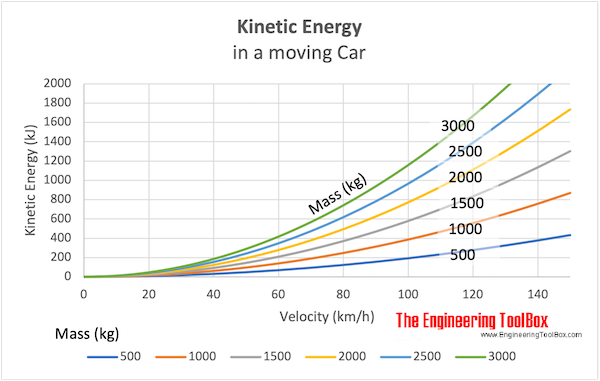
Download and print Kinetic Energy in a Moving Car chart
Example - Kinetic Energy in a Steel Cube moving on a Conveyor Belt
A steel cube with weight 500 lb is moved on a conveyor belt with a speed of 9 ft/s . The steel cube mass can be calculated as
m = (500 lb ) / (32.1740 ft/s2)
= 15.54 slugs
The kinetic energy of the steel cube can be calculated as
E t = 1/2 (15.54 slugs) (9 ft/s)2
= 629 ft lbs
Example - Kinetic Energy in a Flywheel
A flywheel with Moment of Inertia I = 0.15 kg m2 is rotating with 1000 rpm (revolutions/min) . The angular velocity can be calculated as
ω = (1000 revolutions /min) (0.01667 min/s) (2 π rad/ revolution )
= 104 rad/s
The flywheel kinetic energy can be calculated
E r = 1/2 (0.15 kg m2) (104 rad/s) 2
= 821 J
Related Topics
-
Dynamics
Motion of bodies and the action of forces in producing or changing their motion - velocity and acceleration, forces and torque. -
Mechanics
The relationships between forces, acceleration, displacement, vectors, motion, momentum, energy of objects and more.
Related Documents
-
Angular Motion - Power and Torque
Angular velocity and acceleration vs. power and torque. -
Car Acceleration
Car acceleration calculator. -
Car Fuel Consumption - liter/100 km
Calculate fuel consumption in liter per km - consumption chart and calculator. -
Conservation of Momentum
The momentum of a body is the product of its mass and velocity - recoil calculator. -
Conveyors - Belt Speed
Maximum conveyor belt speed. -
Distance Traveled vs. Speed and Time - Calculator and Chart
Velocity plotted in time used diagram. -
Dynamic Pressure
Dynamic pressure is the kinetic energy per unit volume of a fluid in movement. -
Energy Storage Density
Energy density - by weight and volume - for some ways to store energy -
Flywheels - Kinetic Energy
The kinetic energy stored in flywheels - the moment of inertia. -
Formulas of Motion - Linear and Circular
Linear and angular (rotation) acceleration, velocity, speed and distance. -
Fuel Consumption - mpg
Calculate fuel consumption in miles per gallon - mpg - calculator and consumption charts. -
Heat, Work and Energy
Heat vs. work vs. energy. -
Impact Force
Impact forces acting on falling objects hitting the ground, cars crashing and similar cases. -
Impulse and Impulse Force
Forces acting a very short time are called impulse forces. -
Pitot Tubes
Pitot tubes can be used to measure fluid flow velocities by measuring the difference between static and dynamic pressure in the flow. -
Potential Energy - Hydropower
Elevation and potential energy in hydropower. -
Projectile Range
Calculate the range of a projectile - a motion in two dimensions. -
Rolling Resistance
Rolling friction and rolling resistance. -
Salt Hydrates - Melting points and Latent Melting Energy
Melting points and latent energy of salt hydrates. -
Vehicle - Distance Traveled vs. Velcocity and Time Used (mph)
Speed (mph) and time (hours) and distance traveled (miles) chart. -
Vehicle - Distance Traveled vs. Velocity and Time (km/h)
Speed (km/h) vs. time (hours) and distance traveled (km). -
Wind Load vs. Wind Speed
Wind load on surface - Wind load calculator.



