
Conservation of Momentum
The momentum of a body is the product of its mass and velocity - recoil calculator.
Linear Momentum
The momentum of a body is defined as the product of its mass and velocity. Since velocity is a vector quantity - momentum is a vector quantity.
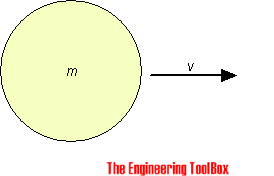
The momentum of a body can be expressed as
ML = m v (1)
where
ML = linear momentum (kg m/s, lb ft/s)
m = mass of body (kg, lb)
v = velocity of body (m/s, ft/s)
The momentum of a body remains the same as long as there is no external forces acting on it. The principle of conservation of momentum can be stated as
the total linear momentum of a system is a constant
The total momentum of two or more bodies before collision in a given direction is equal to the total momentum of the bodies after collision in the same direction and can be expressed as
ML = m1 v1 + m2 v2 + .. + mn vn
= m1 u1 + m2 u2 + .. + mn un (2)
where
v = velocities of bodies before collision (m/s, ft/s)
u = velocities of bodies after collision (m/s, ft/s)
Example - Linear Momentum
A body with mass 30 kg and velocity 30 m/s collides with a body with mass 20 kg and velocity 20 m/s. The velocities of both bodies are in the same direction. Assuming the both bodies have same velocity after impact - the resulting velocity can be calculated as:
ML = (30 kg) (30 m/s) + (20 kg) (20 m/s)
= u ((30 kg) + (20 kg))
= constant
transformed:
u = (30 kg) (30 m/s) + (20 kg) (20 m/s) / ((30 kg) + (20 kg))
= 26 (m/s)
Example - Recoil Velocity after Rifle Shoot
A rifle weighing 6 lb fires a bullet weighing 0.035 lb with muzzle speed 2100 ft/s. The total momentum of the rifle and bullet can be expressed as
ML = mr vr + mb vb
= mr ur + mb ub
The rifle and the bullet are initially at rest (vr = vb = 0):
ML = (6 lb) (0 ft/s) + (0.035 lb) (0 ft/s)
= (6 lb) ur (ft/s) + (0.035 lb) (2100 ft/s)
= 0
The rifle recoil speed:
ur = - (0.035 lb) (2100 ft/s) / (6 lb)
= - 12.25 (ft/s)
The recoil kinetic energy in the rifle can be calculated as
E = 1/2 m ur2
= 1/2 (6 lb) (-12.25)2
= 450 lb ft
The force required to slow down a recoil depends on the slow down distance. With a slow down distance s = 1.5 in (0.125 ft) - the acting force can be calculated as
F = E / s
= (450 lb ft) / (0.125 ft)
= 3600 lb
Recoil Calculator
Angular Momentum
Angular momentum for a rotating body can be expressed as
MR = ω I (3)
where
MR = angular momentum of rotating body (kg m2 / s, lbf ft s)
ω = angular velocity (rad/s)
I = moment of inertia - an object's resistance to changes in rotation direction (kg m2, slug ft2)
The conservation of angular momentum can be expressed as
ω1 I1 = ω2 I2 (4a)
or
n1 I1 = n2 I2 (4b)
where
n = rotation velocity in revolutions per minute (rpm)
For a small point mass I = m r2 and ω = v / r and 4a can be modified to
m v1 r1 = m v2 r2 (4c)
or
v1 r1 = v2 r2 (4d)
or
ω1 r1 = ω2 r2 (4e)
or
n1 r1 = n2 r2 (4f)
where
v = tangential velocity (m/s, ft/s)
r = radius (m, ft)
Example - Small Sphere
A small iron sphere rotates around an axis with velocity 100 rpm when connected to a rope with length 1.5 m. The rope is extended to 2.5 m and due to conservation of angular momentum the new velocity can be calculated by modifying 4f to
n2 = n1 r1 / r2
= (100 rpm) (1.5 m) / (2.5 m)
= 60 rpm
Related Topics
-
Mechanics
The relationships between forces, acceleration, displacement, vectors, motion, momentum, energy of objects and more.
Related Documents
-
Acceleration
Change in velocity vs. time used. -
Angular Motion - Power and Torque
Angular velocity and acceleration vs. power and torque. -
Centripetal and Centrifugal Acceleration Force
Forces due to circular motion and centripetal / centrifugal acceleration. -
Formulas of Motion - Linear and Circular
Linear and angular (rotation) acceleration, velocity, speed and distance. -
Impact Force
Impact forces acting on falling objects hitting the ground, cars crashing and similar cases. -
Impulse and Impulse Force
Forces acting a very short time are called impulse forces. -
Kinetic Energy
Energy possessed by an object's motion is kinetic energy. -
Projectile Range
Calculate the range of a projectile - a motion in two dimensions.



