
Sound Intensity
Acoustic power of sound per unit area.
Sound Intensity
The sound intensity is the sound power transmission through a surface (W/m2) - a vector quantity with direction through a surface.
I = N / A (1)
where
I = sound intensity (W/m2)
N = sound power through surface area (W)
A = surface area (m2)
Sound Intensity Level
The dynamic range of human hearing and sound intensity spans from 10-12 W/m2 to 10 - 100 W/m2. The highest sound intensity possible to hear is 10,000,000,000,000 times as loud as the quietest!
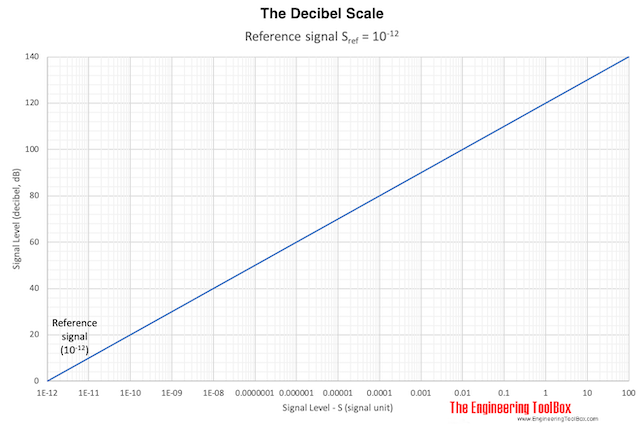
This span makes absolute values for sound intensity impractical in normal use. A more convenient way to express sound intensity is the relative logarithmic decibel scale with reference to the lowest human hearable sound - 10-12 W/m2 (0 dB).
Note! In US the reference 10-13 watts/m2 is commonly used.
Sound Intensity Level can be expressed as:
LI = 10 log (I / Iref)
= 10 log10(I) + 120 (2)
where
LI = sound intensity level (dB)
I = sound intensity (W/m2)
Iref = 10-12 - reference sound intensity - the threshold of hearing (W/m2)
The logarithmic sound intensity level scale match the human sense of hearing. Doubling the intensity increases the sound level with 3 dB(10 log (2)).
Example - Sound Intensity
The difference in dB for intensity 10-8 watts/m2 and 10-4 watts/m2 (10000 units) can be calculated as
ΔLI = 10 log ((10-4 watts/m2) / (10-12 watts/m2)) - 10 log (( 10-8 watts/m2) / ( 10-12 watts/m2))
= 40 dB
Increasing the sound intensity by a factor of
- 10 raises its level by 10 dB
- 100 raises its level by 20 dB
- 1000 raises its level by 30 dB
- 10000 raises its level by 40 dB
- and so on
Note! Since the sound intensity level may be difficult to measure it is common to use sound pressure level measured in decibels instead. Note that doubling sound pressure raises the sound pressure level with 6 dB.
Loudness
Sound loudness is a subjective term describing the ear's perception of a sound.
Sound intensity and feeling of loudness:
- 110 to 225 dB - Deafening
- 90 to 100 dB - Very Loud
- 70 to 80 dB - Loud
- 45 to 60 dB - Moderate
- 30 to 40 dB - Faint
- 0 - 20 dB - Very Faint
Sound Power, Intensity and Distance to Source
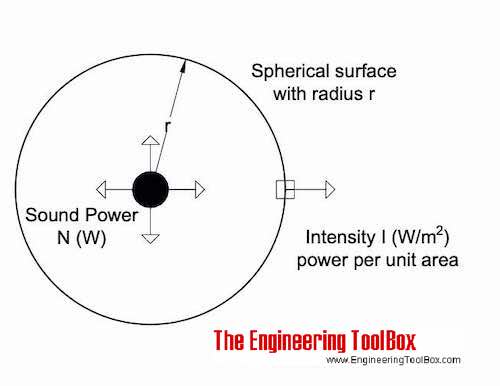
Sound intensity decreases with the distance to the source. Sound intensity vs. distance can be expressed:
I = N / 4 πr2 (3)
where
N = sound power (W)
π = 3.14
r = radius or distance from source (m)
Sound Intensity and Sound Pressure
The relation between Sound Intensity and Sound Pressure can be expressed as
I = p2 / ρ c (4)
where
p = sound pressure (Pa)
ρ = density air (1.2 kg/m3 at 20oC)
c = speed of sound (331 m/s)
The relation between Sound Intensity Level and Sound Pressure Level is
LI = Lp - 0.2 (5)
where
Lp = sound pressure level (dB)
Related Topics
-
Acoustics
Room acoustics and acoustic properties. decibel A, B and C calculations. Noise Rating (NR) curves. Sound transmission through walls. Calculate sound pressure, sound intensity and sound attenuation. -
Noise and Attenuation
Noise is usually defined as unwanted sound - noise, noise generation, silencers and attenuation in HVAC systems.
Related Documents
-
Air - Speed of Sound vs. Temperature
Speed of sound in air at standard atmospheric pressure with temperatures ranging -40 to 1000 °C (-40 to 1500 °F) - Imperial and SI Units. -
Decibel
Logarithmic unit used to describe ratios of signal levels - like power or intensity - to a reference level. -
Human Effects when Exposed to Low-Frequency Noise or Vibration
Physiological effects from low-frequency noise or vibrations. -
Maximum Sound Pressure Levels in Rooms
Maximum recommended sound pressure levels in rooms like kindergartens, auditoriums, libraries, cinemas and more. -
Phonetic Alphabet
The phonetic alphabet used in international aircraft communications. -
Propagation of Sound Indoors - the Room Constant
In a room the sound or noise will reach the receiver as direct and reverberant sound. -
Sound - Abatement vs. the Distance from Source
The disruption of the sound pressure wave and the reduction of noise is called attenuation - Sound Pressure Level vs. distance calculator. -
Sound - Hearing Threshold vs. Age
Shift in hearing threshold for men and women vs. age. -
Sound Intensity, Power and Pressure Levels
Introduction to decibel, sound power, intensity and pressure. -
Sound Power
Sound power from sources like fans, jet engines, cars, humans and more.



