
Human Effects when Exposed to Low-Frequency Noise or Vibration
Physiological effects from low-frequency noise or vibrations.
The physiological effect of low-frequency noise and vibration peak amplitudes on a body:
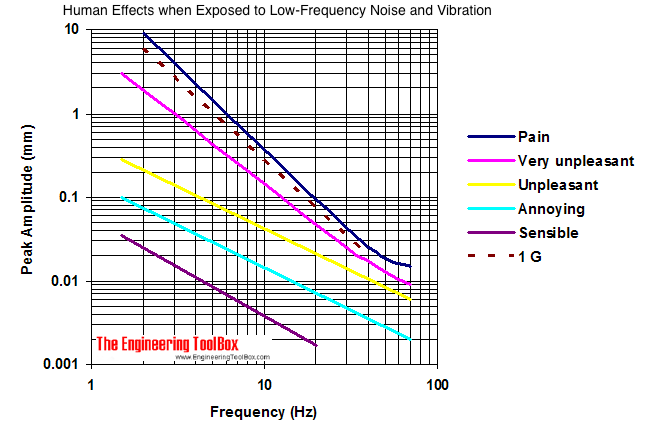
Comfort Assessments of Vibration Environments
| Vibration Level - Acceleration (m/s2) | Human Perception |
|---|---|
| < 0.315 | Not uncomfortable |
| 0.315 - 0.63 | A little uncomfortable |
| 0.5 - 1 | Fairly uncomfortable |
| 0.8 - 1.6 | Uncomfortable |
| 1.25 - 2.5 | Very uncomfortable |
| > 2 | Extremely uncomfortable |
- 1 m/s2 = 3.28 ft/s2
Related Topics
-
Noise and Attenuation
Noise is usually defined as unwanted sound - noise, noise generation, silencers and attenuation in HVAC systems. -
Physiology
Human physiology vs. air quality, comfort temperatures, activity and metabolic rates. Health effects of gases adn polutions like carbon monoxide and more.
Related Documents
-
Beams Natural Vibration Frequency
Estimate structures natural vibration frequency. -
Decibel A, B and C
Sound pressure filters that compensates for the hearing sensed by the human ear. -
Floor Vibrations
Human activities like walking, running and dancing - and operating machines - can introduce floor vibrations due to resonance. -
Low-Frequency Vibrations Effects on Building Constructions
Effects of low-frequency vibrations on building constructions. -
Noise - Acceptable dBA Level
Acceptable noise - dBA - level at typical common locations. -
Noise Criterion vs. Noise Rating and dB(A)
Comparing Noise Criterion (NC, NCB, RNC) to Noise Rating (NR) and dB(A). -
Noise Exposure - Permissible Levels and Duration
Exposure to noise should be controlled so that it is less than a maximum combination of exposure level and duration. -
pH in Human Biological Material
pH in human materials like blood, salvia and more. -
Sound Intensity
Acoustic power of sound per unit area. -
Sound Pressure
Sound Pressure is the force of sound on a surface perpendicular to the propagation of sound. -
Subjective Effect of Change in Sound Pressure Level
Change in sound pressure level and the subjective human perception.



