
Humid Air - Heating
Enthalpy change and temperature rise when heating humid air without adding moisture.
The process of sensible heating of air - heating without adding moisture - can be visualized in the Mollier diagram as:
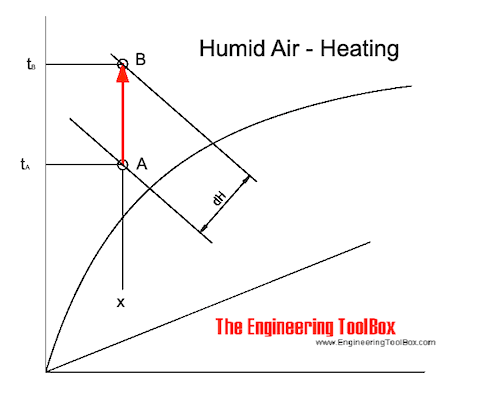
Sensible heating of air changes the state of the air from A to B along the constant specific humidity - x - line. The supplied heat - dH - can be estimated as indicated in the diagram above.
The heating process can also be visualized in the psychrometric chart
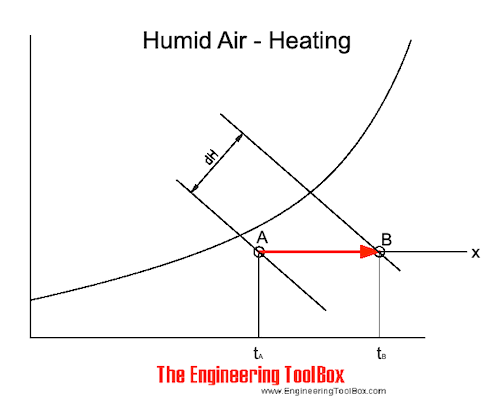
Note! - when sensible heating of air - the specific moisture remains constant - the relative humidity is decreased.
Calculating Enthalpy
The enthalpy of moist air can be calculated as:
h = c pa t + x [c pw t + h we ] (1)
where
h = specific enthalpy of moist air (kJ/kg)
c pa = 1.01 - specific heat capacity of air at constant pressure (kJ/kg oC, kWs/kgK)
t = air temperature (oC)
x = humidity ratio (kg/kg)
c pw = 1.84 - specific heat capacity of water vapor at constant pressure (kJ/kg. oC, kWs/kg.K)
h we = 2502 - evaporation heat of water at 0 oC (kJ/kg)
(1) can be modified to:
h = 1.01 (kJ/kg. oC) t + x [1.84 (kJ/kg. oC) t + 2502 (kJ/kg)] (1b)
The Enthalpy Difference
The enthalpy difference when heating air without adding moisture can be calculated as:
dh A-B = c pa t B + x [c pw t B + h we ] - c pa t A + x [c pw t A + h we ]
= c pa (t B - t A ) + x c pw (t B - t A ) (2)
Example - Enthalpy Change when Heating Air
The specific humidity of air at 25 oC and relative moisture 50% is 0.0115 kg/kg - check the Mollier diagram . The change in enthalpy when heating the air to 35 oC can be calculated as:
dh A-B = (1.01 kJ/kg oC)(35 oC - 25 oC) + (0.0115 kg/kg) (1.84 kJ/kg oC) (35 oC - 25 oC)
= (10.1 kJ/kg) + (0.2 kJ/kg)
= 10.3 (kJ/kg)
Note! - the contribution from the water vapor is relatively small and can for practical purposes often be neglected. (2) can then be modified to:
dh A-B = c pa ( t B - t A ) (2b)
Increase in Temperature when Heating Air
If heat is added to humid air the increase in air temperature can be calculated by modifying (2b) to:
t B - t A = dh A-B / c pa (2c)
Example - Heating Air and Temperature Rise
If 10.1 kJ is added to 1 kg air the temperature rise can be calculated as:
t B - t A = (10.1 kJ/kg) / (1.01 kJ/kg oC)
= 10 (oC)
Heat Flow in a Heating Coil
The total heat flow rate through a heating coil can be calculated as:
q = m (h B - h A ) (3)
where
q = heat flow rate (kJ/s, kW)
m = mass flow rate of air (kg/s)
The total heat flow can also be expressed as:
q s = L ρ (h B - h A ) (3a)
where
L = air flow rate (m3 /s)
ρ = density of air (kg/m3 )
Note! The density of air varies with temperature. At 0 oC the density is 1.293 kg/m3 . At 80 oC the density is 1.0 kg/m3 .
It's common to express sensible heat flow rate as:
q = m c pa (t B - t A ) (3b)
or alternatively:
q = L ρ c pa (t B - t A ) (3c)
Heating Coil Effectiveness
For a limited heating coil surface the average surface temperature will always be higher than the outlet air temperature. The effectiveness of a heating coil can be expressed as:
μ = (t B - t A ) / (t HC - t A ) (4)
where
μ = heating coil effectiveness
t HC = mean surface temperature of the heating coil (oC)
Example - Heating Air
1 m3 /s of air at 15 oC and relative humidity 60% (A) is heated to 30 oC (B). The surface temperature of the heating coil is 80 oC . The density of air at 20 oC is 1.205 kg/m3 .
From the Mollier diagram the enthalpy in (A) is 31 kJ/kg and in (B) 46 kJ/kg .
The heating coil effectiveness can be calculated as:
μ = (30 oC - 15 oC) / (80 oC - 15 oC)
= 0.23
The heat flow can be calculated as:
q = (1 m3 /s) (1.205 kg/m3 ) ((46 kJ/kg) - (31 kJ/kg))
= 18 (kJ/s, kW)
As an alternative, as one of the most common methods:
q = (1 m3 /s) (1.205 kg/m3 ) (1.01 kJ/kg. oC) (30 oC - 15 oC)
= 18.3 (kJ/s, kW)
Note! Due to the inaccuracy when working with diagrams there is a small difference between the total heat flow and the sum of the latent and sensible heat. In general - this inaccuracy is within acceptable limits.
Related Topics
-
Air Psychrometrics
Moist and humid air calculations. Psychrometric charts and Mollier diagrams. Air-condition systems temperatures, absolute and relative humidities and moisture content in air.
Related Documents
-
Air - Drying Force
The drying force of air depends on the air moisture holding capacity and the water surface to air evaporation capacity. -
Air - Heating, Cooling, Mixing, Humidifying or Dehumidifying Processes
Basic air changing state processes - heating, cooling, mixing, humidifying and dehumidifying by adding steam or water - psychometric diagrams and the Mollier charts. -
Air - Humidifying with Steam, SI units
Using steam to humidify air. -
Air - Humidity Measurement from Dry and Wet Bulb Temperature
Relative humidity in moist air can estimated by measuring the dry and wet bulb temperature. -
Air - Maximum Moisture Carrying Capacity
Maximum water content in humid air vs. temperature. -
Air - Specific Heat vs. Temperature at Constant Pressure
Online calculator with figures and tables showing specific heat (Cp and Cv) of dry air vs. temperature and pressure. SI and imperial units. -
Air - Thermal Conductivity vs. Temperature and Pressure
Online calculator with figures and tables showing air thermal conductivity vs. temperature and pressure. SI and imperial units. -
Air - Thermophysical Properties
Thermal properties of air at different temperatures - density, viscosity, critical temperature and pressure, triple point, enthalpi and entropi, thermal conductivity and diffusivity and more. -
Air Cooling of Storage Roooms
Heat removed from storage rooms with cooled air. -
Air Heating Systems
Air heating buildings - heat supply vs. air flow and temperature. -
Cooling and Heating Equations
Latent and sensible cooling and heating equations - imperial units. -
Cooling Load - Latent and Sensible Heat
Latent and sensible cooling loads to consider when designing HVAC systems. -
Dry Air - Thermodynamic and Physical Properties
Thermodynamic properties of dry air - specific heat, ratio of specific heats, dynamic viscosity, thermal conductivity, Prandtl number, density and kinematic viscosity at temperatures ranging 175 - 1900 K. -
Great Sensible Heat Factor - GSHF
The Great Sensible Heat Factor is the ratio sensible to total heat in a cooling coil. -
Heat Recovery
Ventilation and heat-recovery calculations, sensible and latent heat - online calculators - imperial units. -
Heat Recovery Efficiency
Classification of heat recovery efficiencies - temperature efficiency, moisture efficiency and enthalpy efficiency - online heat exchanger efficiency calculator. -
Latent Heat Flow
Latent heat is the heat when supplied to or removed from air results in a change in moisture content - the temperature of the air is not changed. -
Moist Air - Cooling and Dehumidifying
Cooling and dehumidifying processes of moist and humid air - sensible and latent cooling. -
Moist Air - Enthalpy
Sensible and latent heat of moist air. -
Removing Heat with Air
Calculating heat removed with air by measuring the wet bulb temperature. -
Steam Heating Air
Calculate steam heated air systems.



