
Fans - Efficiency and Power Consumption
Power consumption and typical efficiencies of fans
Fan Power Consumption
The ideal power consumption for a fan (without losses) can be expressed as
Pi = dp q (1)
where
Pi = ideal power consumption (W)
dp = total pressure increase in the fan (Pa, N/m2)
q = air volume flow delivered by the fan (m3/s)
Power consumption at different air volumes and pressure increases are indicated below:
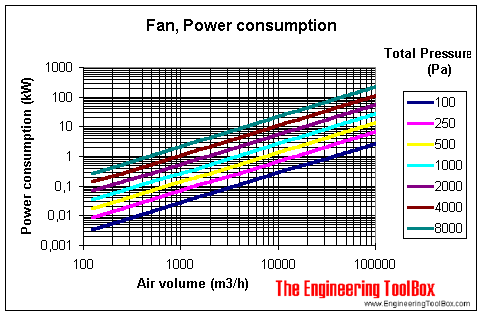
Note! For detailed engineering - use manufacturers specifications for actual fans.
Fan Efficiency
The fan efficiency is the ratio between power transferred to airflow and the power used by the fan. The fan efficiency is in general independent of the air density and can be expressed as:
μf = dp q / P (2)
where
μf = fan efficiency (values between 0 - 1)
dp = total pressure (Pa)
q = air volume delivered by the fan (m3/s)
P = power used by the fan (W, Nm/s)
The power used by the fan can be expressed as:
P = dp q / μf (3)
The power used by the fan can also be expressed as:
P = dp q / (μf μb μm) (4)
where
μb = belt efficiency
μm = motor efficiency
Typical motor and belt efficiencies:
- Motor 1kW - 0.4
- Motor 10 kW - 0.87
- Motor 100 kW - 0.92
- Belt 1 kW - 0.78
- Belt 10 kW - 0.88
- Belt 100 kW - 0.93
Power Consumption - Imperial Units
Fan energy use can also be expressed as
Pcfm = 0.1175 qcfm dpin / (μf μb μm) (4b)
where
Pcfm = power consumption (W)
qcfm = volume flow (cfm)
dpin = pressure increase (in. WG)
Fan and Installation Loss (System Loss)
The installation of a fan will influence on the overall system efficiency
dpsy = xsy pd (5)
where
dpsy = installation loss (Pa)
xsy = installation loss coefficient
pd = dynamic pressure in the nominal intake and outlet of the fan (Pa)
Fan and Temperature Increase
Near all of the energy lost in a fan will heat up the air flow and the temperature increase can be expressed like
dt = dp / 1000 (6)
where
dt = temperature increase (K)
dp = increased pressure head (Pa)
Standards for Fan Efficiency
- ISO 12759 "Fans – Efficiency classification for fans"
- AMCA 205 "Energy Efficiency Classification for fans"
Related Topics
-
Ventilation Systems
Design of systems for ventilation and air handling - air change rates, ducts and pressure drops, charts and diagrams and more.
Related Documents
-
Efficiency
Efficiency is the ratio useful energy output to energy input. -
Fan AMCA Classification
Fan classification established by AMCA. -
Fan Capacity Diagrams
Pressure, head, air flow volume and fan capacity diagrams. -
Fan Motors - Starting Torques
The motor must be capable of accelerating the fan wheel to it's operating speed. -
Fans - Calculate Air and Brake Horsepower
AHP - Air Horse Power and BHP - Brake Horse Power. -
Fans - Capacity Control
How to modulate fans and their capacities. -
Fans - Noise Power Generation
The sound generated by a fan depends on the motor power, the volume capacity, the static pressure increase and the discharged volume. -
Fans - Volume Flow, Pressure Head and Power Consumption vs. Air Temperature and Density
The temperature and density of the air influences on the volume flow, pressure head and power consumption in a fan. -
Power
Power is the rate at which work is done or energy converted. -
Pumps, Fans and Turbines - Horsepower
British Horse Power as used for pumps, fans and turbines - and how to convert to other units. -
Types of Fans
Axial and propeller fans, centrifugal (radial) fans, mixed flow fans and cross flow fans.



