
Hot Water Expansion Tanks - Sizing
Required hot water expansion volume in open, closed and diaphragm tanks.
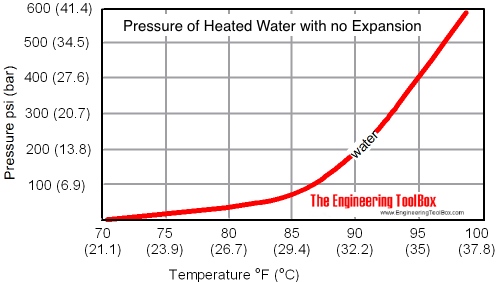
Expansion tanks are required in heating, cooling or air condition system to avoid unacceptable increases of system pressures when water expands during heat-up.
Explosive Power of Super-heated Water
- 1 lb (0.45 kg) of nitroglycerin > 2 000 000 ft lbf (2 700 000 J)
- 1 lb (0.45 kg) of water flashed into steam > 750 000 ft lbf (100 000 J)
Expansion tanks are in general designed as
- open tanks
- closed compression tanks
- diaphragm tanks
Net expansion volume of water when heated can be expressed as
V net = (v1 / v0 ) - 1 (1)
V net = expansion volume of water ( ft3, m3 )
v0 = specific volume of water at initial (cold) temperature (ft3 /lb, m3 /kg)
v1 = specific volume of water at operating (hot) temperature (ft3 /lb, m3 /kg)
Open Expansion Tanks
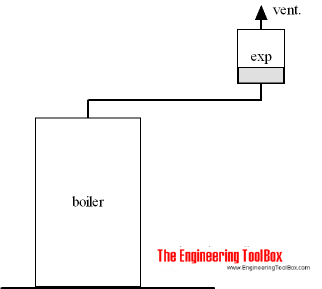
Required volume of an open expansion tank can be expressed as
V et = k V w [(v1 / v0 ) - 1] (2)
V et = required expansion tank volume (gallon, liter)
k = safety factor (approximately 2 is common)
V w = water volume in the system (gallon, liter)
v0 = specific volume of water at initial (cold) temperature (ft3 /lb, m3 /kg)
v1 = specific volume of water at operating (hot) temperature (ft3 /lb, m3 /kg)
Note that in an open expansion tank fresh air is constantly absorbed in the water and tends to corrode the system. Open expansion tanks must also be located above the highest heating element, in general on the top of buildings, where they may be exposed to freezing.

Closed Compression Expansion Tanks
Closed compression tanks can be designed as
- adjustable expansion tanks - air is evacuated or injected by automatic valves to the tanks to control system pressures when temperature and expansion of water rises or falls
- pump-pressured cushion tanks - water is evacuated or injected to the systems to compensate for temperature rise or fall
- compression tanks with closed gas volumes - the tanks contains specific volumes of gas which is compressed when temperatures and system volumes increase
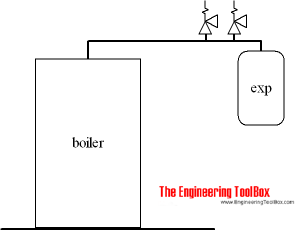
Required volume in a closed expansion tank
V et = k V w [( v1 / v0 ) - 1] / [( p a / p0 ) - ( p a / p1 )] (3)
where
p a = atmospheric pressure - 14.7 (psia)
p0 = system initial pressure - cold pressure (psia)
p1 = system operating pressure - hot pressure (psia)
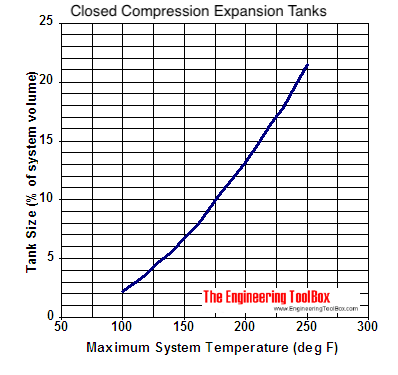
- initial temperature 50 oF
- initial pressure 10 psig
- maximum operating pressure 30 psig
Diaphragm Expansion Tanks
Required volume in a diaphragm expansion tank
V et = k V w [( v1 / v0 ) - 1] / [1 - ( p0 / p1 )] (4)
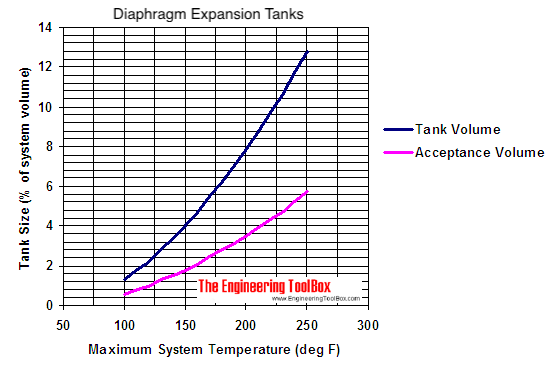
- initial temperature 50 oF
- initial pressure 10 psig
- maximum operating pressure 30 psig
- safety factor aprox. 2
- acceptance factor aprox. 0.5
Example - Volume in Open Expansion Tank
A system with 1000 gallons of water is heated from 68 oF to 176 oF .
Minimum expansion volume in an open expansion tank with a safety factor 2 can be calculated as
V et = 2 (1000 gallons) [((0.01651 ft3 /lb) / (0.01605 ft3 /lb)) - 1]
= 57 (gallons)
Related Topics
-
Heating Systems
Design of heating systems - capacities and design of boilers, pipelines, heat exchangers, expansion systems and more.
Related Documents
-
Closed Expansion Tanks - Volume vs. Temperature and Pressure
Sizing of low temperature closed expansion tanks. -
Diaphragm Expansion Tanks
Low temperature diaphragm expansion tank sizing - calculate tank volume and acceptance volume. -
Ethylene Glycol Heat-Transfer Fluid Properties
Properties like freezing point, viscosity, specific gravity and specific heat of ethylene glycol based heat-transfer fluids, or brines. -
Heat Loss from Buildings
Overall heat transfer loss from buildings - transmission, ventilation and infiltration. -
Heating System Flow Rates
Calculate flow rates in heating systems. -
Hot Water Heating System - Design Procedure
Hot water heating system design procedure with heat loss, boiler rating, heater units and more. -
Hot Water Heating Systems - Flow Temperatures vs. Outside Temperatures
Seasonal effects on hot-water heating systems flow temperatures. -
Hot Water Heating Systems - Online Design Application
Free online design tool for designing hot water heating systems - metric units. -
Hot Water Heating Systems - Online Design Application, Imperial Units
Online design tool for hot water heating systems. -
Hot Water Heating Systems - Pressure Loss in Steel Pipes
Pressure loss nomogram for hot water steel pipes. -
Rectangular Tanks - Volumes
Tank volume per foot depth. -
Safety Relief Valves - Capacities vs. Pressure
Maximum safety valve free air relief capacity. -
Volumetric (Cubic) Thermal Expansion
Volumetric temperature expansion calculator.



