
Electrical Motors - Service Factors
Service factor - SF - is a measure of periodically overload capacity at which a motor can operate without beeing damaged.
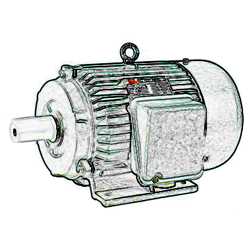
The service factor - SF - is a measure of periodically overload capacity (Design Power) at which a motor can operate without damage. The NEMA (National Electrical Manufacturers Association) standard service factor for totally enclosed motors is 1.0.
A motor operating continuously at a service factor greater than 1 will have a reduced life expectancy compared to operating at at its rated nameplate horsepower.
NEMA Service Factor at Synchronous Speed (rpm) for drip proof motors:
| Motor Power (hp) | Service Factor - SF | |||
|---|---|---|---|---|
| Synchronous Speed (rpm) | ||||
| 3600 | 1800 | 1200 | 900 | |
| 1/6, 1/4, 1/3 | 1.35 | 1.35 | 1.35 | 1.35 |
| 1/2 | 1.25 | 1.25 | 1.25 | 1.25 |
| 3/4 | 1.25 | 1.25 | 1.15 | 1.15 |
| 1 | 1.25 | 1.15 | 1.15 | 1.15 |
| 1 1/2 and up | 1.115 | 1.15 | 1.15 | 1.15 |
Design Power vs. Motor Power and Service Factor can be expressed as
PD = SF P (1)
where
PD = design power (hp, W)
SF =service factor
P = motor power (hp, W)
Example - Design Power vs. Service Factor
A 1 HP motor with a Service Factor - SF= 1.15 can operate at
PD = (1 hp) x 1.15
= 1.15 hp
without overheating or otherwise damaging the motor if rated voltage and frequency are supplied to the motor.
Insulation life and bearings life are reduced by the service factor load.
Related Topics
-
Electrical
Electrical engineering with units, amps and electrical wiring. Wire gauges, electrical formulas, motors and more.
Related Documents
-
Belt Transmissions - Speed and Length of Belts
Calculate length and speed of belt and belt gearing. -
Belts - Power Transmission and Efficiency
Calculate belts power transmission and efficiency -
Electric Motors - Efficiency
Calculate electric motor efficiency. -
Electrical Induction Motors - Torque vs. Speed
Full load operating torque vs. break down, pull up and locked rotor torque. -
Three-Phase Electrtical Motors - Power Factor vs. Inductive Load
Inductive loads and power factors with electrical three-phase motors. -
Three-Phase Power - Equations
Electrical 3-phase equations.



