
Electrical Induction Motors - Torque vs. Speed
Full load operating torque vs. break down, pull up and locked rotor torque.
Torque is the turning force through a radius - with the units Nm in the SI-system and the units lb ft in the imperial system.
The torque developed by an asynchronous induction motor varies when the motor accelerates from zero to maximum operating speed.
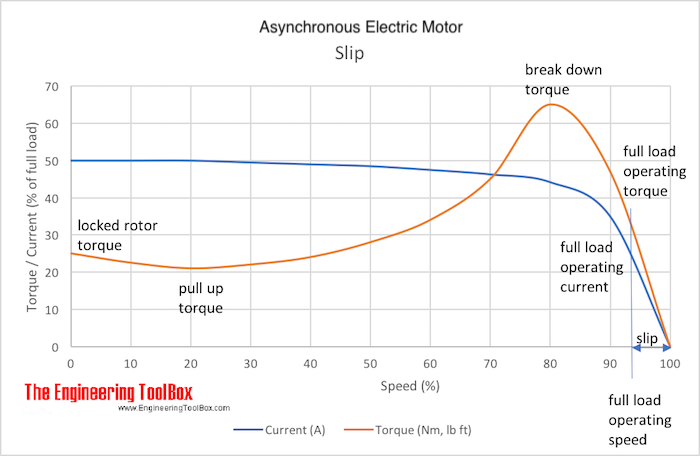
Locked Rotor or Starting Torque
The Locked Rotor Torque or Starting Torque is the torque an electrical motor develops when starting at zero speed.
A high Starting Torque is more important for application or machines hard to start - like positive displacement pumps, cranes etc. A lower Starting Torque can be accepted for centrifugal fans or pumps where the start load is low or close to zero.
Pull-up Torque
The Pull-up Torque is the minimum torque developed by an electrical motor when it runs from zero to full-load speed (before it reaches the break-down torque point).
When a motor starts and begins to accelerate the torque in general will decrease until it reach a low point at a certain speed - the pull-up torque - before the torque increases until it reach the highest torque at a higher speed - the break-down torque - point.
The pull-up torque may be critical for applications that needs power to go through some temporary barriers achieving working conditions.
Break-down Torque
The Break-down Torque is the highest torque available before the torque decreases when the machine continues to accelerate to working conditions.
Full-load (Rated) Torque or Braking Torque
The Full-load Torque is the torque required to produce the rated power of an electrical motor at full-load speed.
In imperial units the Full-load Torque can be expressed as
T = 5252 Php / nr (1)
where
T = full load torque (lb ft)
Php = rated horsepower
nr = rated rotational speed (rev/min, rpm)
In metric units the rated torque can be expressed as
T = 9550 PkW / nr (2)
where
T = rated torque (Nm)
PkW = rated power (kW)
nr = rated rotational speed (rpm)
Example - Electrical Motor and Braking Torque
The torque of a 60 hp motor rotating at 1725 rpm can be calculated as:
Tfl = 5252 (60 hp) / (1725 rpm)
= 182.7 lb ft
NEMA Design
NEMA (National Electrical Manufacturers Association) have classified electrical motors in four different designs where torques and starting-load inertia are important criteria.
Accelerating Torque
Accelerating Torque = Available Motor Torque - Load Torque
Reduced Voltage Soft Starters
Reduced Voltage Soft Starters are used to limit the start current reducing the Locked Rotor Torque or Starting Torque and are common in applications which is hard to start or must be handled with care - like positive displacement pumps, cranes, elevators and similar.
Related Topics
-
Electrical
Electrical engineering with units, amps and electrical wiring. Wire gauges, electrical formulas, motors and more.
Related Documents
-
Asynchronous Induction Motors - Electrical Properties
Typical electrical motor data like nominal current, fuse, start ampere, size of contactor and circuit breaker - for asynchronous induction motors. -
Electric Motors - IEC and NEMA Standard Torques
IEC and NEMA torque classifications of electrical motors. -
Electric Motors - Torque vs. Power and Speed
Electric motor output power and torque vs. rotation speed. -
Electrical Induction Motors - Slip
Slip is the difference between an electrical induction motor's synchronous and asynchronous speed. -
Electrical Induction Motors - Synchronous Speed
Operating speed of an induction motor depends on the input power frequency and the number of magnetic poles in the motor. -
Electrical Motors - Horsepower vs. Voltage and Amps
Electrical motors horsepower rating vs. their ampere rating. -
Electrical Motors - Locked Rotor Design Code Letters
NEMA locked rotor indicating code letters for electrical motors. -
Electrical Motors - Service Factors
Service factor - SF - is a measure of periodically overload capacity at which a motor can operate without beeing damaged. -
Electrical Motors - Speed at Operating vs. Synchronous Load
Speed of an operating electrical motor with load is lower than the synchronous speed (no load) of the motor. -
Electrical Motors - Starting Devices
Direct-on-line starters, star-delta starters, frequency drives and soft starters. -
Electrical Vehicle Charging - Power vs. Voltage and Amps
EV Charging - AC vs. DC, single phase vs. three phase and power vs. voltage and amps. -
Fan Motors - Starting Torques
The motor must be capable of accelerating the fan wheel to it's operating speed. -
NEMA A, B, C and D Electrical Motor Design
NEMA has established the four different designs A, B, C and D for electrical induction motors. -
Torque - Work done and Power Transmitted
The work done and power transmitted by a constant torque.



