
Polyurethane Insulation
Thermal conductivity - k-values - vs. temperature.
Polyurethane is an organic polymer formed by reacting a polyol (an alcohol with more than two reactive hydroxyl groups per molecule) with a diisocyanate or a polymeric isocyanate in the presence of suitable catalysts and additives.
Polyurethanes are flexible foams used in mattresses, chemical-resistant coatings, adhesives and sealants, insulation for buildings and technical applications like heat exchangers, cooling pipes and much more.
Thermal conductivity vs. temperature are indicated in the charts below:
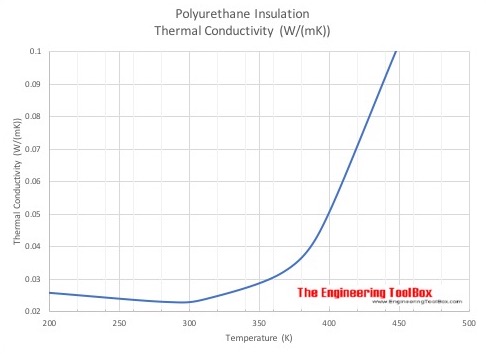
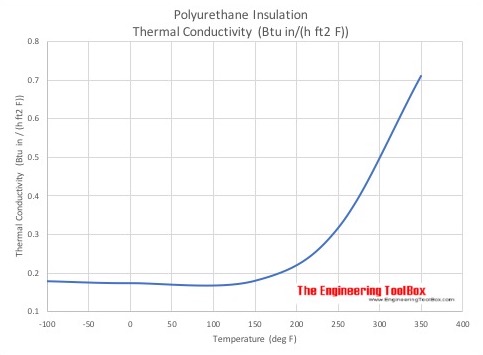
- T(oC) = 5/9[T(oF) - 32]
- 1 W/(m K) = 6.935 (Btu in)/(h ft² °F)
Related Topics
-
Heat Loss and Insulation
Heat loss from pipes, tubes and tanks - with and without insulation. Use of materials lke foam, fiberglass, rockwool and more. -
Insulation
Calculate heat transfer and heat loss from buildings and technical applications. Heat transfer coefficients and insulation methods available for reduction of energy consumption.
Related Documents
-
Calcium Silicate Insulation
Thermal conductivity of calcium silicate insulation - temperature and k-values. -
Fiberglass Insulation
Thermal conductivity of fiberglass insulation - temperature and k-values. -
Insulation Materials - Operating Temperature Limits
Temperature limits for commonly used insulation materials. -
Mineral Wool Insulation
Thermal conductivity - k-values - vs. temperature. -
Perlite Insulation
Thermal conductivity - k-values - vs. temperature. -
Pipes - Insulated Heat Loss Diagrams
Heat loss (W/m) from 1/2 to 6 inches insulated pipes - ranging insulation thickness 10 to 80 mm and temperature differences 20 to 180 degC. -
Pipes - Insulated Heat Loss Diagrams
Heat loss (W/ft) diagrams for 1/2 to 6 inches insulated pipes - ranging insulation thickness 0.5 to 4 inches and temperature differences 50 to 350 degF. -
Piping - Recommended Insulation Thickness
Recommended insulation thickness for heating systems like hot water and low, medium or high pressure steam systems. -
Polyurethane - Chemical Resistance
Chemical resistance of Polyurethane (PUR). -
Steel Pipes - Heat Loss Diagram
Heat loss from steel pipes and tubes - dimensions 1/2 to 12 inches. -
Thermal Resistivity and Conductivity
The ability of a material to resist flow of heat. -
Transmission Heat Loss through Building Elements
Heat loss through common building elements due to transmission, R-values and U-values - imperial and SI units. -
Water - Thermal Conductivity vs. Temperature
Figures and tables showing thermal conductivity of water (liquid and gas phase) with varying temperature and pressure, SI and Imperial units.



