
Heat Emission from Radiators and Heating Panels
The heat emission from a radiator or a heating panel depends on the temperature difference between the radiator and the surrounding air.
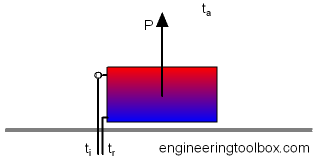
Heat emission from a radiator or a heating panel depends primarily on the temperature difference between the hot surface and the surrounding air. The heat emission can be calculated
P = P50 [((ti - tr) / ln((ti - ta) / (tr - ta))) (1 / 49.32)]n (1)
where
P = heat emission from radiator (W, J/s)
P50 = heat emission from radiator with temperature difference 50 oC (W)
ti = water temperature inlet (oC)
tr = water temperature outlet (oC)
ta = surrounding air temperature (oC)
n = constant describing the type of radiator (1.33 for standard panel radiators, 1.3 - 1.6 for convectors)
Note that radiators are in general designed for middle panel temperature 70oC - and surrounding air temperature 20oC (difference 50oC)
Example - Heat Emission from Radiator
The heat emission from a radiator with nominal*) heat emission 1000 W with water inlet temperature ti = 70oC and outlet temperature tr = 50oC can be calculated
P = (1000 W) [(((70 oC) - (50 oC)) / ln(((70 oC) - (20 oC)) / ((50 oC) - (20 oC)))) (1 / 49.32)]1.33
= 736 W
*) nominal when inlet water temperature ti = 80oC, outlet water temperature out tr = 60oC and surrounding air temperature ta = 20oC
Radiator Heat Emission Calculator
Heat Emission and Water Flow
The calculator below can be used to calculate heat emission and water flow from a radiator operating outside the standard conditions - like increasing or decreasing the water inlet or outlet temperature or increasing or decreasing the surrounding room air temperature.
Return Temperature Water and Flow
The calculator below can be used to calculate the water return temperature and the water volume flow through radiators based on actual heat emission and inlet water temperatures.
Oversized radiators are quite common since it is almost never possible to adapt a standard radiator exactly to the required heat loss from a room. With the calculator below it is possible to study the consequence of out of standard heat emission when a radiator is oversized.
When checking heat emission capacities of radiators - be aware that testing standards differs. Examples of standards:
- BS 3528 "Specification for convection type space heaters operating with steam or hot water" (withdrawn, replaced by BS EN442) - flow temperature 90oC, return temperature 70oC, air temperature 20oC
- BS EN442 "Specification for radiators and convectors." - flow temperature 75oC, return temperature 65oC, air temperature 20oC
Testing the same radiator with BS EN442 compared to BS 3528 reduces the heat output with approximately 11%.
Related Topics
-
Heating Systems
Design of heating systems - capacities and design of boilers, pipelines, heat exchangers, expansion systems and more.
Related Documents
-
Arithmetic and Logarithmic Mean Temperature Difference
Arithmetic Mean Temperature Difference in Heat Exchangers - AMTD - and Logarithmic Mean Temperature Difference - LMTD - formulas with examples - Online Mean Temperature Calculator. -
Heat Loss from Buildings
Overall heat transfer loss from buildings - transmission, ventilation and infiltration. -
Heating Systems - Steam and Condensate Loads
Calculating steam and condensate loads in steam heated systems. -
Hot Water Heating System - Design Procedure
Hot water heating system design procedure with heat loss, boiler rating, heater units and more. -
Hot Water Heating Systems - Online Design Application
Free online design tool for designing hot water heating systems - metric units. -
Hot Water Heating Systems - Online Design Application, Imperial Units
Online design tool for hot water heating systems. -
Radiators - Heat Emission
Calculate heat emission from column and panel radiators. -
Steam Radiators and Convectors - Heating Capacities
Steam radiators and steam convectors - heating capacities and temperature coefficients.



