
Noise generated in Air Ducts
Estimate noise generated by air flow in ducts.
Air flow in ducts generates noise. The noise in the duct is determined by
- air velocity
- duct size (cross sectional area)
Generated noise can be calculated with the empirical equation
LN = 10 + 50 log (v) + 10 log (A) (1)
where
LN = sound power level in the duct (dB)
v = air velocity (m/s)
A = air duct cross sectional area (m2)
The equation modified for imperial units
LN = 10 + 50 log (vi / 197) + 10 log (Ai / 1550) (1b)
where
vi = air velocity (ft/min)
Ai = cross sectional area (in2)
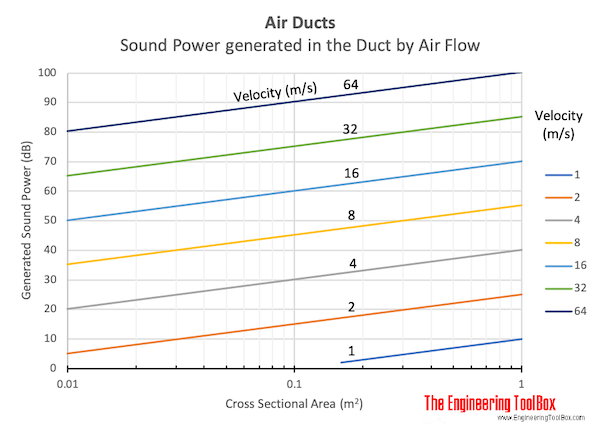
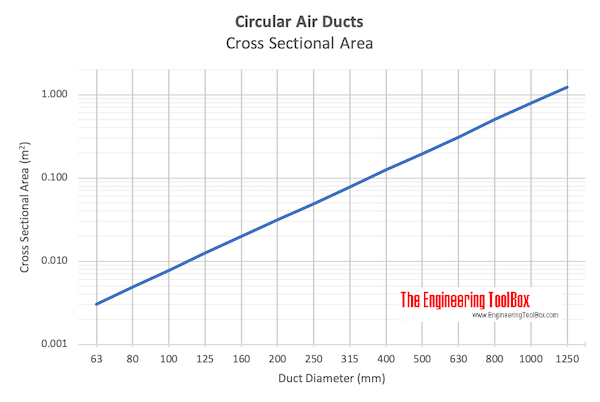
Example - Generated Noise in Duct by Air Flow
The cross section area of a 200 mm duct can be calculated as
A = π ((0.2 m) / 2)2)
= 0.0314 m2
The noise generated in the duct with an air flow velocity 10 m/s can be calculated as
LN = 10 + 50 log (10 m/s) + 10 log (0.0314 m2)
= 45 db
The noise generated in the same 200 mm circular duct as above with air flow velocity 20 m/s can be calculated as
LN = 10 + 50 log (20 m/s) + 10 log (π ((0.2 m) / 2)2)
= 60 db
Note! - due to the noise generated by fans - noise generated inside ducts by air flow can in general be neglected.
Related Topics
-
Acoustics
Room acoustics and acoustic properties. decibel A, B and C calculations. Noise Rating (NR) curves. Sound transmission through walls. Calculate sound pressure, sound intensity and sound attenuation. -
Noise and Attenuation
Noise is usually defined as unwanted sound - noise, noise generation, silencers and attenuation in HVAC systems.
Related Documents
-
Decibel
Logarithmic unit used to describe ratios of signal levels - like power or intensity - to a reference level. -
Ducts Sizing - the Velocity Reduction Method
The velocity reduction method can be used when sizing air ducts. -
Ductwork - Seal Classes
Ductwork air leakage classes. -
Fans - Noise Power Generation
The sound generated by a fan depends on the motor power, the volume capacity, the static pressure increase and the discharged volume. -
Noise Attenuation in Rotary Heat Exchanges
Sound attenuation vs. frequency in rotating heat exchangers. -
Signals - Adding Decibels
The logarithmic decibel scale is convenient when adding signal values like sound power, pressure and others from two or more sources. -
Velocity Classification of Ventilation Ducts
Recommended air velocities in ventilation ducts



