
Control Valves - Cavitation
Control valves and cavitation, application ratio and multi stage control valves.
According the Bernoulli equation - when a fluid pass a valve seat and the fluid velocity increase - the fluid pressure decrease.
Cavitation
If the speed through the valve is increases enough, the pressure in the fluid drops to a level where the fluid may start to boil, bubble or flash. And when the pressure recovers sufficiently the bubbles will collapse upon themselves. This collapse causes cavitation.
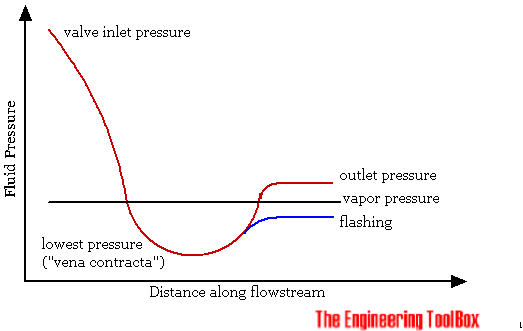
Cavitation may be noisy but is usually of low intensity and low frequency. This situation is extremely destructive and may wear out the trim and body parts of a valve in short time.
- Cavitation Number - introduction and definition of the Cavitation Number
- Cavitation - an Introduction
Application Ratio
A common way to characterize potential cavitation condition is the "applications ratio" (or "the incipient cavitation index") which can be expressed as
AR = pi - po / (pi - pv) (1)
where
AR = Application Ratio
pi = inlet pressure, absolute
po = outlet pressure, absolute
pv = vapor pressure of the fluid, absolute
For application ratios above 1 - the fluid flashes. This is not the same as cavitation, but the closer the ratio is to 1, the higher is the potential for cavitation.
Note! - the risk of cavitation increases with fluid temperature.
Example - Flashing Water
If we know the boiling point and the absolute pressure of a fluid (Steam Table with saturated steam properties) the minimum outlet pressure from a valve to avoid flashing can be calculated.
For an application ratio like one (AR = 1), equation (1) can modified to
AR = 1
= pi - po / (pi - pv)
or transformed to
po = pv
Using the "Steam Table" with saturated steam properties we can conclude that
- for a water temperature of 17.51 oC and absolute inlet pressure of 1 bar - the minimum outlet pressure is 0.02 bar to avoid flashing
- for a water temperature of 81.35 oC and absolute inlet pressure of 1 bar - the minimum outlet pressure is 0.5 bar to avoid flashing
- For a water temperature of 99.63 oC and absolute inlet pressure of 1 bar - the minimum outlet pressure is 1 bar to avoid flashing
Note! Flashing is not the same as cavitation. Due to local conditions in a valve cavitation may start on much higher outlet pressures.
Multi Stage Control Valves
Cavitation can be avoided by using more than one control valve or more convenient - a multistage control valve.
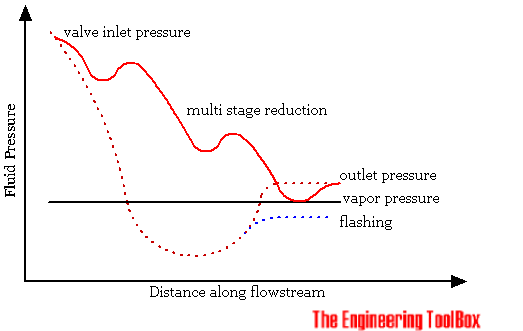
As illustrated above the "vena contracta" is much lower in a single stage valve than in a multi stage valve. Depending on the pressure drop and the temperature of the fluid its possible to avoid cavitation conditions using more than one stage in a valve.
Related Topics
-
Control Valve Sizing
Control Valve terminology, bodies, trim, flow characteristics, Cv and Kv sizing, noise, actuators, positioners and more.
Related Documents
-
API 6D Valves - Pressure Ratings vs. Temperature
Temperature and pressure ratings for valves according API 6D. -
ASTM A216 Valves - Pressure Ratings vs. Temperature
Pressure and temperature ratings for cast carbon steel valves. -
Ball Valves - Flow Coefficients Cv
Flow coefficients - Cv - for typical ball valves - reduced and full bore. -
Cavitation
Cavitation occurs in fluid flow systems where the local static pressures are below the fluids vapor pressure. -
Cavitation Number
An introduction and definition of the Cavitation Number. -
Liquids - Critical Pressure Ratios
Critical pressure ratios for water and other liquids. -
Saturated Steam - Properties for Pressure in Bar
Saturated Steam Table with properties like boiling point, specific volume, density, specific enthalpy, specific heat and latent heat of vaporization. -
Steam Control Valves - Calculate Flow Factor Kv
Designing steam control valves and their Kv values. -
Straight Through Diaphragm Valves - Flow Coefficients
Flow coefficients - Cv - and flow factors - Kv - for straight through diaphragm valves. -
Valve Authority
The valve authority expresses the ratio between pressure drop across the control valve compared to total pressure drop across the whole system. -
Valve Type Classifications
Categories of valves. -
Valves - Typical Operating Temperatures
Operating temperatures for typical categories of valves - ball valves, butterfly valves and more. -
Valves Types - Operating Size Ranges
Types of valves and their typical operating sizes. -
Weir Diaphragm Valves - Flow Coefficients and Flow Factors
Typical flow coefficients - Cv - and flow factors - Kv - for weir diaphragm valves.



