
PNC - the Preferred Noise Criterion
A noise measurement system for continuous or ambient noise in indoor environments.
Preferred Noise Criterion Curves - PNC - is a noise measurement system for continuous or ambient noise in indoor environments proposed by Leo Beranek in 1971.
PNC is often used to judge the acceptability of ventilation and other background broad band noise sources.
Preferred Noise Criterion Curves - PNC - was introduced as a modification of the Noise Criterion - NC due to unacceptable low frequency noise in air-conditioning systems. The PNC at lower frequencies is more stringent than NC.
| PNC | Center frequency (Hz) | ||||||||
|---|---|---|---|---|---|---|---|---|---|
| 31.5 | 63.0 | 125 | 250 | 500 | 1000 | 2000 | 4000 | 8000 | |
| PNC - 15 | 58 | 43 | 35 | 28 | 21 | 15 | 10 | 8 | 8 |
| PNC - 20 | 59 | 46 | 39 | 32 | 26 | 20 | 15 | 13 | 13 |
| PNC - 25 | 60 | 49 | 43 | 37 | 31 | 25 | 20 | 18 | 18 |
| PNC - 30 | 61 | 52 | 46 | 41 | 35 | 30 | 25 | 23 | 23 |
| PNC - 35 | 62 | 55 | 50 | 45 | 40 | 35 | 30 | 28 | 28 |
| PNC - 40 | 64 | 59 | 54 | 50 | 45 | 40 | 35 | 33 | 33 |
| PNC - 45 | 67 | 63 | 58 | 54 | 50 | 45 | 41 | 38 | 38 |
| PNC - 50 | 70 | 66 | 62 | 58 | 54 | 50 | 46 | 43 | 43 |
| PNC - 55 | 73 | 70 | 66 | 62 | 59 | 55 | 51 | 48 | 48 |
| PNC - 60 | 76 | 73 | 69 | 66 | 63 | 59 | 56 | 53 | 53 |
| PNC - 65 | 79 | 76 | 73 | 70 | 67 | 64 | 61 | 58 | 58 |
PNC-type criteria provide no protection for low frequency sound exposure, and further, tend to rely on the public's increasing toleration of background noise and what seems to be decreasing auditory skills.
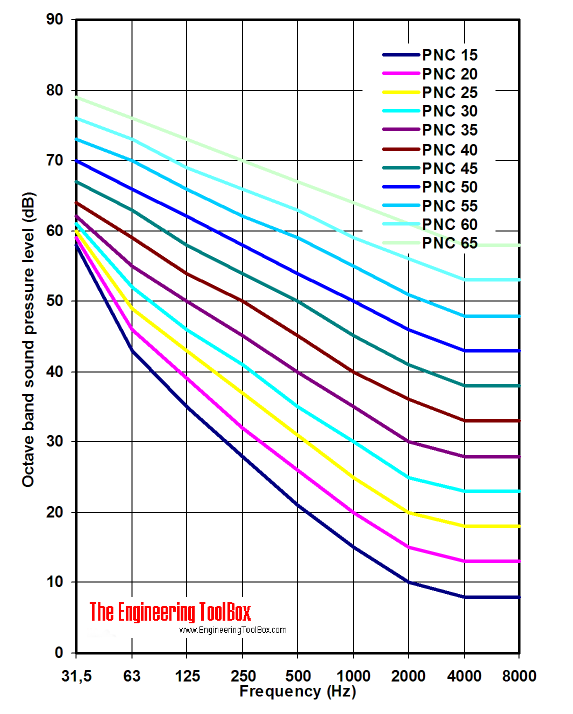
Example - Estimating PNC - Preferred Noise Criterion
The Preferred Noise Criterion - PNC - of a noise spectrum like
- 31.5 Hz : 40 dB
- 62.5 Hz : 40 dB
- 125 Hz : 50 dB
- 250 Hz : 55 dB
- 500 Hz : 60 dB
- 1000 Hz : 50 dB
- 2000 Hz : 55 dB
- 4000 Hz : 45 dB
- 8000 Hz : 45 dB
can be estimated to
PNC = 57 dB
as indicated in the diagram below.

Related Topics
-
Acoustics
Room acoustics and acoustic properties. decibel A, B and C calculations. Noise Rating (NR) curves. Sound transmission through walls. Calculate sound pressure, sound intensity and sound attenuation.
Related Documents
-
NC - the Noise Criterion
Noise Criterion - NC - level is a standard uesd to describe the relative loudness of a space within a range of frequencies. -
Noise - Acceptable dBA Level
Acceptable noise - dBA - level at typical common locations. -
Noise - EPA Protective Levels
The noise level should not exceed certain values to protect public health and welfare. -
Noise Criterion (NC) - Free Online Calculator
Calculate Noise Criterion (NC) from octave band pressure levels. -
Noise Rating (NR) - Free Online Calculator
An online Noise Rating (NR) calculator. -
NR - the Noise Rating Curve
The Noise Rating (NR) Curve used to determine acceptable indoor environments for hearing preservation, speech communication and annoyance. -
Preferred Noise Criterion (PNC) - Calculator
An online Preferred Noise Criterion (PNC) calculator.



