
Vacuum
Vacuum is defined as air pressure below atmospheric pressure.
The vacuum level is the difference in pressure between atmospheric pressure and pressure in the evacuated system:
- 0% vacuum = 760 torr = 14.7 psia = 29.92 inc mercury abs = 101.4 kPa abs
- 50% vacuum = 380 torr = 7.3 psia = 15 inc mercury abs = 50.8 kPa abs
- 99.9% vacuum = 1 torr = 0.01934 psia = 0.03937 inc mercury abs = 1.3 kPa abs
For perfect vacuum (100%) - the pressure is 0 torr, 0 psia or 0 Pa abs.
Vacuum versus Absolute Air Pressure
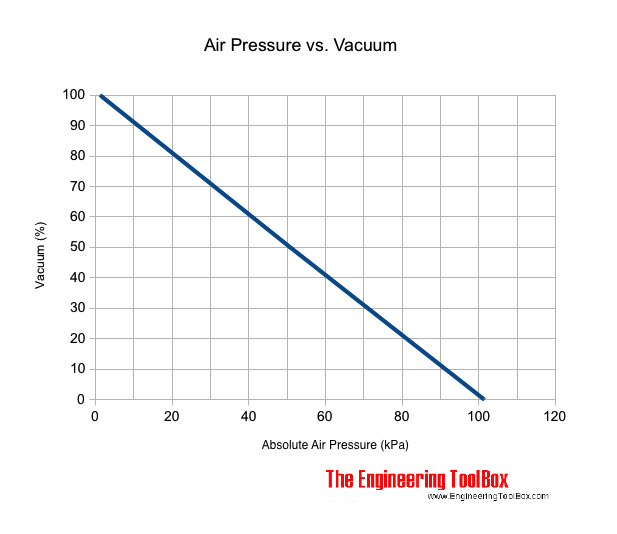
Example - Vacuum
If the absolute pressure is 60 kPa the vacuum according the diagram above is approximately 40 % - or approximately 450 Torr .
Vacuum Ranges
- atmospheric pressure - 760 torr
- low vacuum - 760 to 25 torr
- medium vacuum - 25 to 10-3 torr
- high vacuum - 10-3 to 10-9torr
- ultra high vacuum - 10-9to 10-12 torr
- extremely high vacuum - < 10-12 torr
- perfect vacuum - 0 torr <
Related Topics
-
Gases and Compressed Air
Properties of air, LNG, LPG and other common gases. Pipeline capacities and sizing of relief valves.
Related Documents
-
Atmospheric Pressure vs. Elevation above Sea Level
Elevation above sea level - in feet and meter - with barometric and atmospheric pressure - inches mercury, psia, kg/cm2 and kPa. -
Vacuum - Air Expansion Ratio
Convert vacuum air volume to standard air volume -
Vacuum - Evacuation Time
Vacuum pumps - calculate flow rate and required evacuation time. -
Vacuum - Flow Measurement
Measure air volume flow in vacuum. -
Vacuum - Pressure Units Converter
Converting between vacuum units like % vacuum - mm Mercury - psi - torr - micron - kPa. -
Vacuum Pipes - Flow Velocities
Air velocity diagrams for vacuum pipe lines. -
Vacuum Pipes - Pressure Loss vs. Air Flow
Calculate pressure drops in vacuum pipe lines. -
Vacuum Pumps - Exhaust Pipe Capacities
Capacities of vacuum pump exhaust pipes. -
Water - Boiling Points at Vacuum Pressure
Online calculator, figures and tables giving the boiling temperatures of water in varying vacuum, SI and Imperial units.



