
Thermocouples
Thermocouples - types, principles and temperature ranges.
One of the most common industrial thermometer is the thermocouple. It was discovered by Thomas Seebeck's in 1822. He noted that a voltage difference appeared when the wire was heated at one end. Regardless of temperature, if both ends were at the same temperature there was no voltage difference. If the circuit were made with wire of the same material there was no current flow.
A thermocouple consists of two dissimilar metals, joined together at one end, and produce a small unique voltage at a given temperature. This voltage is measured and interpreted by a thermocouple thermometer.
The thermoelectric voltage resulting from the temperature difference from one end of the wire to the other is actually the sum of all the voltage differences along the wire from end to end.
Thermocouples can be made from a variety of metals and cover a temperature range 200 oC to 2600 oC. Comparing thermocouples to other types of sensors should be made in terms of the tolerance given in ASTM E 230.
Base metal thermocouples
| Thermocouple | Maximum Temperature (oC) | Temperature Sensitivity (mV/oC) | |
|---|---|---|---|
| Continuous | Spot | ||
| Copper-Constantan (type T) | 400 | 500 | 0.045 |
| Iron-Constantan (type J) | 850 | 1100 | 0.041 |
| Chromel-Constantan (type E) | 700 | 1000 | 0.041 |
| Chromel-Alumel (type K) | 1100 | 1300 | 0.041 |
| Nicrosil-Nisil (type N) | 1250 | 0.039 | |
| Tungsten-Molybdenum* | 2600 | 2650 | |
* Not used below 1250 oC.
Advantages with thermocouples
- Capable of being used to directly measure temperatures up to 2600 oC.
- The thermocouple junction may be grounded and brought into direct contact with the material being measured.
Disadvantages with thermocouples
- Temperature measurement with a thermocouple requires two temperatures be measured, the junction at the work end (the hot junction) and the junction where wires meet the instrumentation copper wires (cold junction). To avoid error the cold junction temperature is in general compensated in the electronic instruments by measuring the temperature at the terminal block using with a semiconductor, thermistor, or RTD.
- Thermocouples operation are relatively complex with potential sources of error. The materials of which thermocouple wires are made are not inert and the thermoelectric voltage developed along the length of the thermocouple wire may be influenced by corrosion etc.
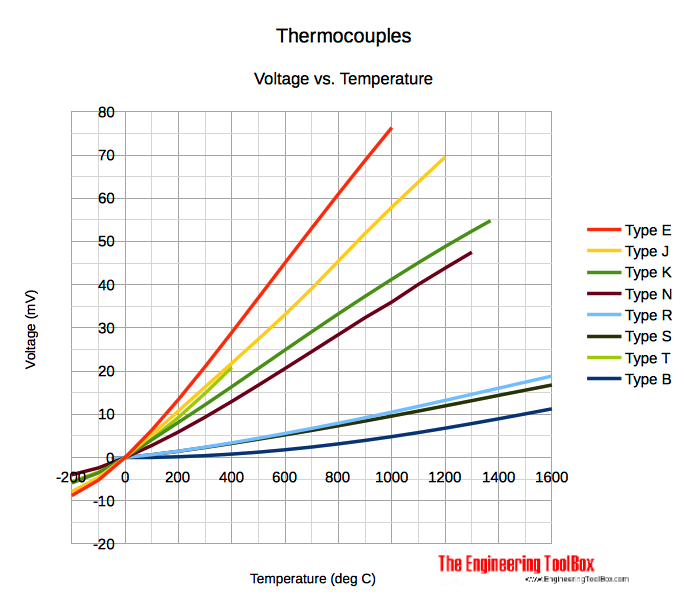
- The relationship between the process temperature and the thermocouple signal (millivolt) is not linear.
- The calibration of a thermocouple should be carried out by comparing it to a nearby thermocouple. If the thermocouple is removed and placed in a calibration bath the output integrated over the length is not reproduced exactly since the temperature difference from one end of the wire to the other is the sum of all voltage differences along the wire from end to end.
Thermocouple Types
Thermocouples are available in different combinations of metals or calibrations. The four most common calibrations are J, K, T and E. Each calibration has a different temperature range and environment, although the maximum temperature varies with the diameter of the wire used in the thermocouple.
Some of the thermocouple types have standardized with calibration tables, color codes and assigned letter-designations. The ASTM Standard E230 provides all the specifications for most of the common industrial grades, including letter designation, color codes (USA only), suggested use limits and the complete voltage versus temperature tables for cold junctions maintained at 32 oF and 0 oC.
There are four "classes" of thermocouples:
- The home body class (called base metal),
- the upper crust class (called rare metal or precious metal),
- the rarified class (refractory metals) and,
- the exotic class (standards and developmental devices).
The home bodies are the Types E, J, K, N and T. The upper crust are types B, S, and R, platinum all to varying percentages. The exotic class includes several tungsten alloy thermocouples usually designated as Type W (something).
| Instrument | Temperature Range (oF) | Accuracy | |
|---|---|---|---|
| Recommended | Maximum | ||
| Type J probes | 32 - 1336 | -310 - 1832 | 1.8 to 7.9oF or 0.4% of reading above 32oF, whichever is greater |
| Type K probes | 32 - 2300 | -418 - 2507 | 1.8 to 7.9oF or 0.4% of reading above 32oF, whichever is greater |
| Type T probes | -299 - 700 | -418 - 752 | 0.9 to 3.6oF or 0.4% of reading above 32oF, whichever is greater |
| Type E probes | 32 - 1600 | 32 - 1650 | 1.8 to 7.9oF or 0.4% of reading above 32oF, whichever is greater |
| Type R probes | 32 - 2700 | 32 - 3210 | 2.5oF or 0.25% of reading, whichever is greater |
| Type S probes | 32 - 2700 | 32 - 3210 | 2.5oF or 0.25% of reading, whichever is greater |
Temperature Conversions
- oF = (1.8 x oC) + 32
- oC = (oF - 32) x 0.555
- Kelvin = oC + 273.2
- oRankin = oF + 459.67
ASTM Standards Related to Thermocouples
- E 207-00...Method of Thermal EMF Test of Single Thermo element Materials by Comparison with a Secondary Standard of Similar EMF-Temperature Properties
- E 220-02 Standard Test Method for Calibration of Thermocouples By Comparison Techniques
- E 230-98e1..Temperature Electromotive Force (EMF) Tables for Standardized Thermocouples
- E 235-88(1996)e1..Specification for Thermocouples, Sheathed, Type K, for Nuclear or Other High-Reliability Applications
- E 452-02..Test Method for Calibration of Refractory Metal Thermocouples Using a Radiation Thermometer
- E 574-00..Specification for Duplex, Base-Metal Thermocouple Wire with Glass Fiber or Silica Fiber Insulation
- E 585/E 585M-01a ..Standard Specification for Compacted Mineral-Insulated, Metal-Sheathed, Base Metal Thermocouple Cable
- E 601-81(1997)..Test Method for Comparing EMF Stability of Single-Element Base-Metal Thermocouples Materials in Air
- E 608/E 608M-00. Standard Specification for Mineral-Insulated, Metal-Sheathed Base-Metal Thermocouples
- E 696-00 Standard Specification for Tungsten-Rhenium Alloy Thermocouple Wire
- E 710-86(1997) Standard Test Method for Comparing EMF Stabilities of Base-Metal Thermo elements in Air Using Dual, Simultaneous, Thermal-EMF Indicators
- E 780-92(1998) Standard Test Method for Measuring the Insulation Resistance of Sheathed Thermocouple Material at Room Temperature
- E 839-96 Standard Test Method for Sheathed Thermocouples and Sheathed Thermocouple Material
- E 988-96(2002) Standard Temperature-Electromotive Force (EMF) Tables for Tungsten-Rhenium Thermocouples
- E1129/E1129M-98 Standard Specification for Thermocouple Connectors
- E 1159-98 Standard Specification for Thermocouple Materials, Platinum-Rhodium Alloys and Platinum
- E 1350-97(2001) Standard Test Methods for Testing Sheathed Thermocouples Prior to, During and After Installation
- E 1652-00 Standard Specification for Magnesium Oxide and Aluminum Oxide Powder and Crushable Insulators Used in the Manufacture of Metal-Sheathed Platinum Resistance Thermometers, Base Metal Thermocouples, and Noble Metal Thermocouples
- E 1684-00 Standard Specification for Miniature Thermocouple Connectors
- E 1751-00 Standard Guide for Temperature Electromotive Force (emf) Tables for Non-Letter Designated Thermocouple Combinations
- E 2181/E 2181M-01 Standard Specification for Compacted Mineral-Insulated, Metal-Sheathed, Noble Metal Thermocouples and Thermocouple Cable
Related Topics
-
Process Control Systems
Instrumentation, design and documentation of process control systems. -
Temperature Measurements
Measurment of temperature - probes, sensors and transmitters.
Related Documents
-
Air - Humidity Measurement from Dry and Wet Bulb Temperature
Relative humidity in moist air can estimated by measuring the dry and wet bulb temperature. -
Fixed Temperature Points
Temperature points that can be used as a reference for calibration -
Globe Temperature
The resultant or globe temperature. -
Pt100 - Platinum Resistance Thermometer
Pt100 electrical resistance temperature sensor - ranging -220 to 750 degrees Celsius. -
RTD Resistance Temperature Sensor
Thermal resistive sensor - a basic introduction. -
STP - Standard Temperature and Pressure and NTP - Normal Temperature and Pressure
The definition of STP - Standard Temperature and Pressure and NTP - Normal Temperature and Pressure. -
Temperature
Introduction to temperature - including Celsius, Fahrenheit, Kelvin and Rankine definitions - and an online temperature converter. -
Temperature Sensors - Comparing Types
Comparing advantages and disadvantages of thermocouples, RTDs and thermistors temperature sensors.



