
Target - Volume Flow Meters
Introduction to the target flow meters principles.
With the target meter a physical target is located directly in the fluid flow.
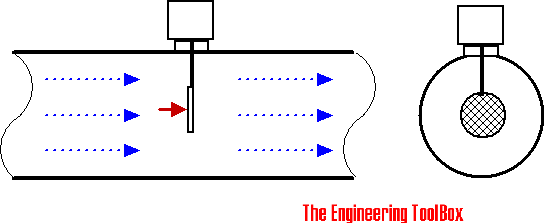
The deflection of the target and the force bar is measured in the instrument.
The force on the target can be expressed as
F =cd ρ v2 At / 2 (1)
where
F = force on the target (N)
cd = overall drag coefficient obtained from empirical data
ρ = density of fluid (kg/m3)
v = fluid velocity (m/s)
At = target area (m2)
Advantages with the Target Flow Meter
- Can be used for any type of liquid, gas, or steam cryogenics.
- There is no moving parts such as bearings, to wear out causing failures.
- High reliability where life tests have been made to 20,000,000 cycles.
- Can be used for any line size from 0.5 inches and up with any type of mounting.
- Range/fluid changes accomplished by simply changing targets
- Turndowns aprox.15:1
- Can accept bi-directional flow where signal polarity indicates direction.
- Several materials are available. Among them 303/304 SS, 316 SS, hastelloy and inconel.
Disadvantages with the Target Flow Meter
- Calibration must be verified in the field.
Related Topics
-
Flow Measurements
Flow metering principles - Orifice, Venturi, Flow Nozzles, Pitot Tubes, Target, Variable Area, Positive Displacement, Turbine, Vortex, Electromagnetic, Ultrasonic Doppler, Ultrasonic Time-of-travel, Mass Coriolis, Mass Thermal, Weir V-notch, Flume Parshall and Sluice Gate flow meters and more.
Related Documents
-
Comparing Flowmeters
A limited comparison of flowmeter principles - regarding service, rangeability, pressure loss, typical accuracy, upstream pipe diameters, viscosity and relative costs. -
Drag Coefficient
The drag coefficient quantifies the drag or resistance of an object in a fluid environment. -
Flowmeter - Accuracy
Introduction to accuracy in flow measurement devices. -
Flowmeters - Turndown Ratios
Turndown ratio (Rangeability) can be used to compare flow measurement devices like orifices, venturi meters etc.



