
Sluice Gate - Volume Flow Measurements
Sluice gates can be used to control and measure volume flow rates in open channels and rivers, mainly in connection to hydro power plants.
Sluice gate flow metering is often used to measure flow rate in open channels. Sluice gates are also often used to modulate flow.
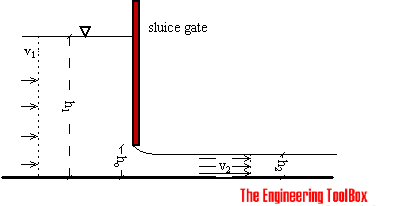
The sluice gate flow rate measurement is based on the Bernoulli Equation and can be expressed as:
1/2 ρ v12 + ρ g h1 = 1/2 ρ v22 + ρ g h2 (1)
where
h = elevation height (m)
ρ = density (kg/m3)
v = flow velocity (m/s)
The pressure components in the equation are in general irrelevant since pressure upstream and downstream are the same (p1 - p2 = 0).
Assuming uniform upstream and downstream velocity profiles - the Continuity Equation gives:
q = v1 A1
= v2 A2 (2)
where
q = flow rate (m3/s)
A = flow area (m2)
(2) can be modified to:
q = v1 h1 b
= v2 h2 b (3)
where
b = width of the sluice (m)
h1 = upstream height (m)
h2 = downstream height (m)
Combining (1) and (3), gives the "ideal" equation:
q = h2 b [2 g (h1 - h2) /(1 -(h2 / h1))]1/2 (4)
Assuming h1 >> h2 (4) can be modified to:
q = h2 b [2 g h1]1/2 (5)
This is approximately true when the depth ratio h1 / h2 is large, the kinetic energy upstream is negligible (v1 is small) and the fluid velocity after it has fallen the distance (h2 - h1) ≈ h1 - is:
v2 = [2 g h1]1/2 (6)
The ideal equation (3) can be modified with a discharge coefficient:
q = cd h0 b [2 g h1]1/2 (7)
where
cd = discharge coefficient
The discharge coefficient depends on different parameters - such as upstream and tail-water depths, gate opening, contraction coefficient of the gate and the flow condition.
In practice the typical discharge coefficient is approximately 0.61 for free flow conditions and depth ratios ho / h1 < 0.2.
Sluice Gate Specifications
The most commonly used specification for sluice gates in water and wastewater treatment plants is ANSI/AWWA C560-00. This specification should be used as a guidance for gates selection and operating equipment and associated hardware.
Example - Flow Rate through a Sluice Gate
Water flows under a sluice gate with an opening height of 0.4 m. The width of the sluice is 3 m and the height from the water surface to the bottom of the sluice is 10 m.
Since h1 >> h2 and the depth ratio 0.4/10 < 0,2 - the contraction coefficient can be set to 0.61 - and equation (7) can be used for flow calculation:
q = 0.61 (0.4 m) (3 m) [2 (9.81 m/s2) (10 m)]1/2
= 10.25 m3/s
Related Topics
-
Flow Measurements
Flow metering principles - Orifice, Venturi, Flow Nozzles, Pitot Tubes, Target, Variable Area, Positive Displacement, Turbine, Vortex, Electromagnetic, Ultrasonic Doppler, Ultrasonic Time-of-travel, Mass Coriolis, Mass Thermal, Weir V-notch, Flume Parshall and Sluice Gate flow meters and more.
Related Documents
-
Bernoulli Equation
Conservation of energy in a non-viscous, incompressible fluid at steady flow. -
California Pipe Flow Metering Method
Calculate the discharge length from the open end of a partially filled horizontal pipe. -
Flowmeter - Accuracy
Introduction to accuracy in flow measurement devices. -
Flowmeters - Turndown Ratios
Turndown ratio (Rangeability) can be used to compare flow measurement devices like orifices, venturi meters etc. -
Fluid Flow - Equation of Continuity
The Equation of Continuity is a statement of mass conservation. -
Fluid Flowmeters - Comparing Types
An introduction to the different types of fluid flowmeters - Orifices, Venturies, Nozzles, Rotameters, Pitot Tubes, Calorimetrics, Turbine, Vortex, Electromagnetic, Doppler, Ultrasonic, Thermal, Coriolis. -
Potential Energy - Hydropower
Elevation and potential energy in hydropower. -
Velocity-Area Flowmetering
Flow rate or discharge in an open conduit, channel or river can be calculated with the velocity-area principle.



