
Pollution Concentration in Rooms
Concentration of a pollution in a limited space as a room depends on the amount of polluted material spread in the room, supply of fresh air, outlets positions and construction, principles used for supply and outlet from the space.
The concentration of a pollution in a limited space as a room, container, tank etc. depends on
- amount of polluted material spread in the room or space
- amount of fresh supply air or fluid
- the outlet positions and constructions
- the principles used for supply and outlet from the space
- fluid flow in the space
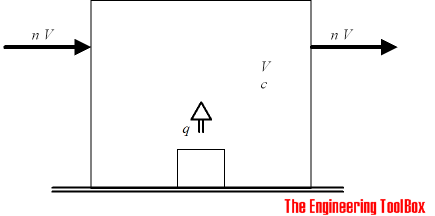
The generic equation for pollution concentration (amount of polluting product to amount of fluid in space (like air a room)) can be calculated
c = q / n V (1 - e-nt) + (c1 - c2) e-nt + c2 (1)
where
c = concentration in the space (or in the room) at perfect mix (m3/m3) (kg/kg)
q = amount of pollution added to the space (m3/h) (kg/h)
n = volume changes per hour (h-1)
V = volume or mass of the space (m3) (kg)
e = the number 2.72..
t = time (h)
c1 = concentration in the space at start (m3/m3) (kg/kg)
c2 = concentration in the supply fluid (m3/m3) (kg/kg)
If the start concentration (t = 0) of the space and the concentration in the supply fluid is zero, equation (1) can be reduced to
c = q / n V (1 - e-nt) (2)
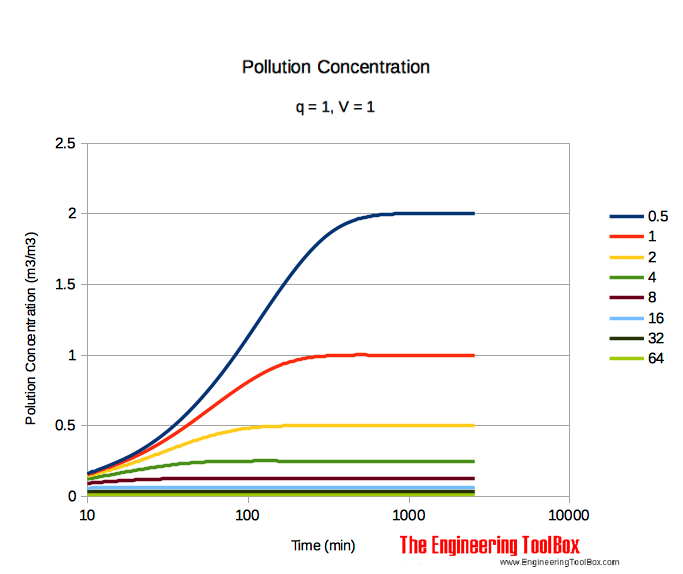
Note! After some time the concentration in the room will stabilize. The table below shows the value of c when the amount of pollution q = 1, and the volume of the space V = 1.
For full table - rotate the screen!
| Volume changes per hour (1/h) | Concentration of pollution - c - (m3/m3) (kg/kg) | ||||||||
|---|---|---|---|---|---|---|---|---|---|
| Time - t - (min) | |||||||||
| 10 | 20 | 40 | 80 | 160 | 320 | 640 | 1280 | 2560 | |
| 0.5 | 0.1599 | 0.3070 | 0.5669 | 0.9732 | 1.4728 | 1.8610 | 1.9903 | 2.0000 | 2.0000 |
| 1 | 0.1535 | 0.2835 | 0.4866 | 0.7364 | 0.9305 | 0.9952 | 1.0000 | 1.0000 | 1.0000 |
| 2 | 0.1417 | 0.2433 | 0.3682 | 0.4653 | 0.4976 | 0.5000 | 0.5000 | 0.5000 | 0.5000 |
| 4 | 0.1216 | 0.1841 | 0.2326 | 0.2488 | 0.2500 | 0.2500 | 0.2500 | 0.2500 | 0.2500 |
| 8 | 0.0921 | 0.1163 | 0.1244 | 0.1250 | 0.1250 | 0.1250 | 0.1250 | 0.1250 | 0.1250 |
| 16 | 0.0582 | 0.0622 | 0.0625 | 0.0625 | 0.0625 | 0.0625 | 0.0625 | 0.0625 | 0.0625 |
| 32 | 0.0311 | 0.0312 | 0.0312 | 0.0313 | 0.0313 | 0.0313 | 0.0313 | 0.0313 | 0.0313 |
| 64 | 0.0156 | 0.0156 | 0.0156 | 0.0156 | 0.0156 | 0.0156 | 0.0156 | 0.0156 | 0.0156 |
Related Topics
-
Ventilation Systems
Design of systems for ventilation and air handling - air change rates, ducts and pressure drops, charts and diagrams and more.
Related Documents
-
Air Change Rates in typical Rooms and Buildings
Fresh air (make up air) rquirements - or recommended air change rates (ACH) for typical rooms and buildings like auditoriums, kitchens, churches and more. -
Air Contaminants - Exposure Limits
Exposure limits for various air contaminants. -
Air Intakes and Outlets
Ventilation systems - air intakes and outlets - rules of thumbs. -
Carbon Dioxide Concentration in Rooms Occupied with People
Carbon dioxide concentration in a room may indicate air quality and ventilation system efficiency. -
Design of Ventilation Systems
Design procedure for ventilation systems - air flow rates, heat and cooling loads, air shifts according occupants, air supply principles. -
Gases Solved in Water - Diffusion Coefficients
Diffusion flux [kg/m2s] tells how fast a substanse solved in another substance flows due to concentration gradients. Diffusion constants [m2/s] for several gases in water. -
Outdoor Supply Air Rates
Recommended supply air rates of outdoor air - with or without smoking - in rooms like banks, assembly halls, hotels and many more.



