
Pressure Gradient Diagrams
Static pressure graphical presentation throughout a fluid flow system.
A pressure-gradient diagram includes only the static and physical pressure in a system and the diagram is suitable for checking energy transformation for the flow through the system. Velocity head is dynamic head and not included as in the Energy and Hydraulic Grade Line Diagram.
The vertical dimension in the pressure-gradient diagram is in scale with the pressure or head unit used for the system. The horizontal dimension is not in scale and is used to separate the specific head and pressure losses through the system.
A pressure-gradient diagram for a basic circulation pump system is illustrated below.
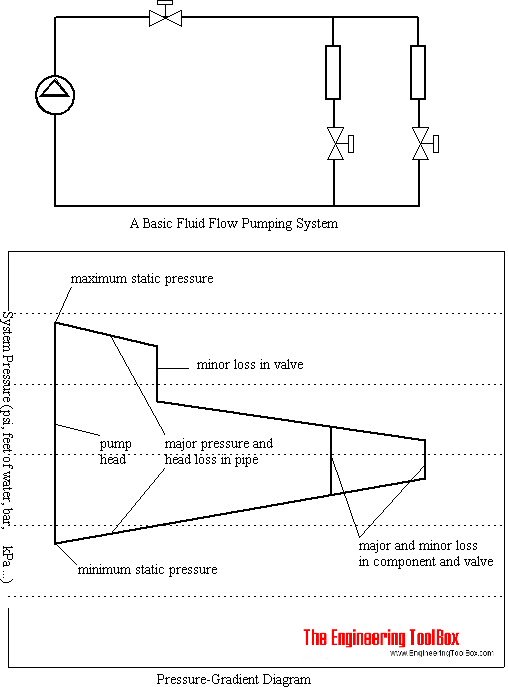
The horizontal falling lines in the diagram visualizes the major head or pressure loss due to friction in the pipes. The vertical lines visualizes the minor head or pressure loss due to valves and components. The vertical lines are important for the sizing of reduction valves needed for balancing the system.
The diagram above shows a static steady state stabilized flow where the flow rate and the minor and major head or pressure losses are constant. In reality it is more common today with modulating systems where flow rates changes due to external conditions - as in heating systems when it's get colder or warmer, or in domestic water supply systems where the demand of water changes over the day.
The pressure-gradient diagram should be drawn for
- the normal condition with normal flow rate
- the extreme condition where the pump deliver a maximum flow rate at the lowest pump head
- the extreme condition where the pump deliver a minimum flow rate at the highest pump head
Analyzing the minimum and maximum conditions is important when designing reduction valves needed to balancing the system. it is also important for an optimized design of modulating control valves in the system.
Related Topics
-
Fluid Flow and Pressure Loss in Pipes and Tubes
Fluid flow and pressure loss in pipe lines. Water and sewer systems. Steel pipes, pvc pipes, copper tubes and more. -
Fluid Mechanics
The study of fluids - liquids and gases. Involving velocity, pressure, density and temperature as functions of space and time.
Related Documents
-
Darcy-Weisbach Equation - Major Pressure and Head Loss due to Friction
The Darcy-Weisbach equation can be used to calculate the major pressure and head loss due to friction in ducts, pipes or tubes. -
Energy and Hydraulic Grade Line
The hydraulic grade line and the energy line are graphical presentations of the Bernoulli equation. -
Energy Equation - Pressure Loss vs. Head Loss
Calculate pressure loss - or head loss - in ducts, pipes or tubes. -
Equivalent Length vs. Minor Pressure Head Loss in Pipe and Duct Components
Minor pressure and head loss in pipes vs. equivalent length in tubes and duct systems. -
Fittings and Minor Pressure Loss
Minor pressure loss with fittings in piping heating systems. -
Hydrostatic Pressure vs. Depth
Depth and hydrostatic pressure. -
Laminar, Transitional and Turbulent Flow
Heat transfer, pressure and head loss in a fluid varies with laminar, transitional or turbulent flow. -
Major Loss Online Calculator - the Darcy-Weisbach Friction Loss Equation
An online major loss calculator based on the Darcy-Weisbach friction loss equation. -
Pipe and Duct Systems - Total Head Loss
Major and minor loss in pipes, tubes and duct systems. -
Pipe and Tube System Components - Minor (Dynamic) Loss Coefficients
Minor loss coefficients for components used in pipe and tube systems. -
Static Pressure vs. Head
Static pressure vs. pressure head in fluids.



