
Pneumatic Powder and Solid Transport Systems
Pneumatic transport systems used to move powder and other solid products.
Some common solids as flour, sugar, cement and many more, can be suspended and transported in air - referred to as pneumatic conveying. A pneumatic conveying system may transport solids up to approximately 50 mm in size. The powder or solid must be dry with no more than 20% moisture and not sticking.
In a pneumatic conveying system most of the energy is used for transport of the air itself. The energy efficiency of a pneumatic conveying plant is therefore relatively low, but this is often outweighed by easy handling and, in well designed systems, dust free solutions.
In general - the length of a pneumatic system should not extend 300 m for each pneumatic unit. Products can be conveyed over long distances by connecting systems in series.
There are three basic designs of pneumatic transport systems:
- dilute phase conveying at high air velocity (20 - 30 m/s)
- strand conveying at limited air velocity (15 - 20 m/s)
- dense phase conveying at low air velocity (5 - 10 m/s)
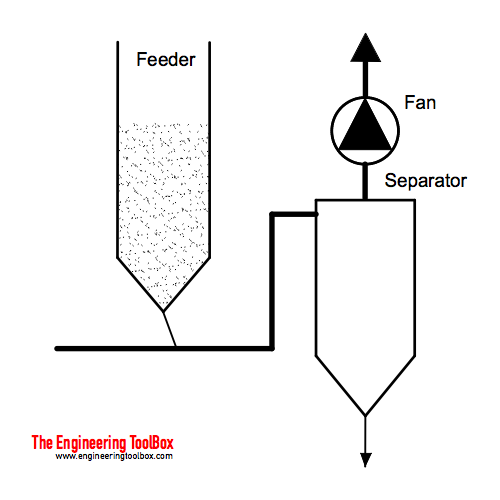
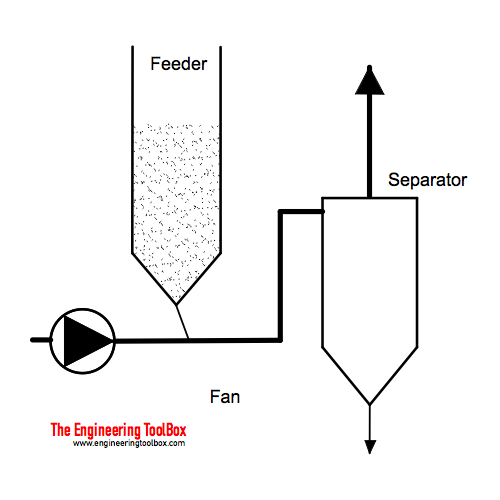
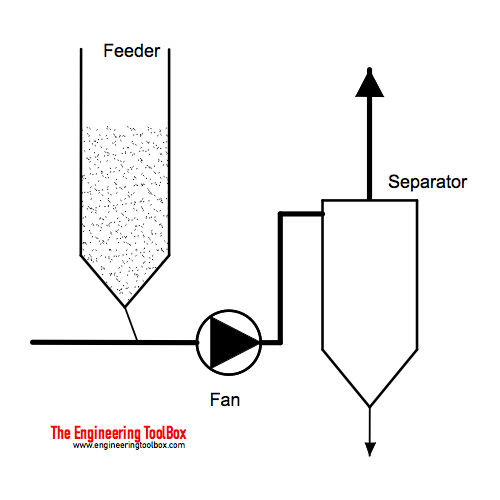
Pneumatic systems can operate with both positive and negative pressure (vacuum). The working pressure should not extend 40 kN/m2.
Negative Pressure Pneumatic Conveying System
Positive Pressure Pneumatic Conveying System
Combination Pressure Pneumatic Conveying System
Maximum temperature rise during the pneumatic compression is seldom more than 5oC which makes pneumatic transport systems suitable to sensitive products like medicines, food and similar.
Related Topics
-
Fluid Flow and Pressure Loss in Pipes and Tubes
Fluid flow and pressure loss in pipe lines. Water and sewer systems. Steel pipes, pvc pipes, copper tubes and more. -
Hydraulics and Pneumatics
Hydraulic and pneumatic systems - fluids, forces, pumps and pistons. -
Piping Systems
Calculate dimensions of pipes and tubes. Pressure drop calculations and head loss charts. Use of different piping materials. Insulation of pipes and tubes and heat loss diagrams.
Related Documents
-
Conveyors - Capacities
Calculate conveyor capacities. -
Conveyors - Load & Power Consumption
Conveyor required power consumption vs. load. -
Conveyors - Maximum Inclination vs. Product
Maximum conveyor inclination slopes for typical products. -
Pneumatic Transport - Solids and Particle Size
Particle sizes for common products like coal, sand, ash and more. -
Pneumatic Transport and Conveying - Carrying Velocities
Recommended air velocity for pneumatic transport of products like cement, coal, flour and more. -
Pneumatic Transporting
An introduction to pneumatic transport of powders. -
Pneumatics - Transport of Solids and Separator Types
Separators used in pneumatic solids transport systems and their minimum particle size. -
Sieve Sizes vs. Mesh Designations
US commercial sieve sizes vs. mesh designations. -
Slurry Transports - Minimum Flow Velocities
Flow velocities in slurry transport systems to avoid settling of solids. -
Stockpile Volumes
Volume of natural stockpiles - cubic feet, yard, metre and decimetre.



