
Ohm's Law
The relation between voltage, current and electrical resistance.
Ohm's law states that
"the current through a conductor between two points is directly proportional to the potential difference or voltage across the two points, and inversely proportional to the resistance between them".
Ohm's law can be expressed as
I = U / R (1)
where
I = electrical current (ampere, A)
U = electrical potential difference, voltage (volts, V)
R = electrical resistance (ohms, Ω )
Example - Ohm's law
A 12 volt battery supplies power to a resistance of 18 ohms . The current in the elctrical circuit can be calculated as
I = (12 volts) / (18 ohm)
= 0.67 ampere
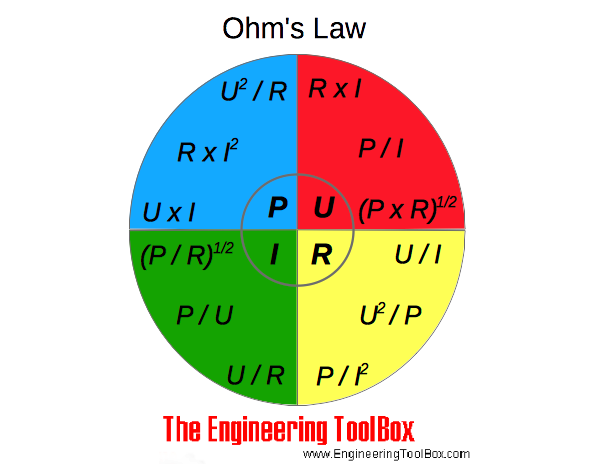
Equivalent Expressions of Ohm's Law
Ohm's law (1) can also be expressed as
U = R I (2)
or
R = U / I (3)
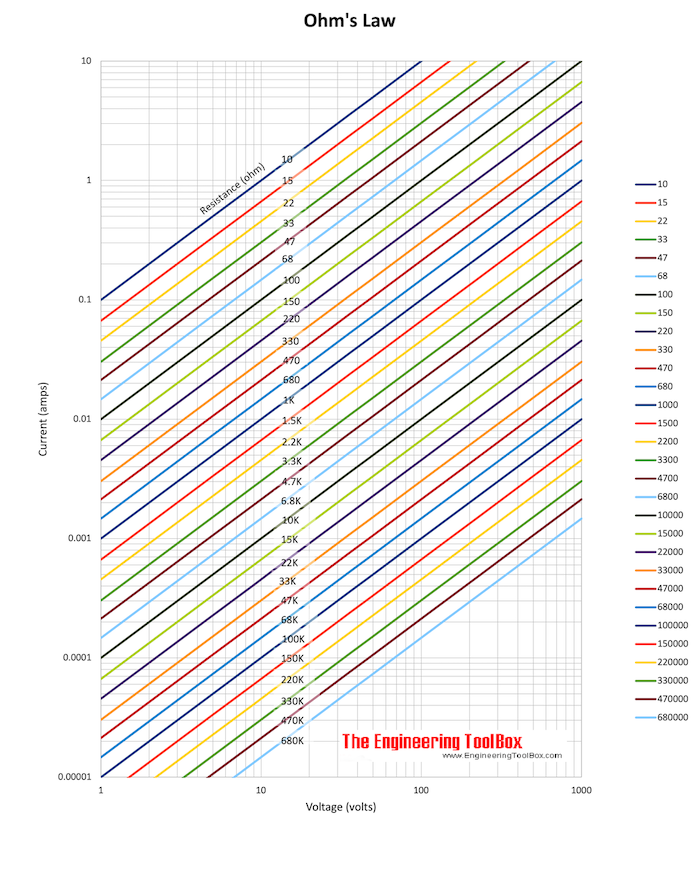
Download and print the Ohm's Law diagram !
Example - Electric Circuit Resistance
A current of 1 ampere is flowing through a 230 V electric circuit. From the diagram above this indicates resistance
R ≈ 220 Ω
This can alternatively be calculated with Ohm's law
R = (230 V) / (1 A)
= 230 Ω
Example - Ohm's Law and Multiples and Submultiples
Currents, voltages and resistances in electric circuits may often be very small or very large - so multiples and submultiples are often used.
The voltage required applied to a 3.3 kΩ resistor to generate a current of 20 mA can be calculated as
U = (3.3 kΩ) (1000 Ω/kΩ) (20 mA) (10-3 A/mA)
= 66 V
Electric Resistance Nomogram
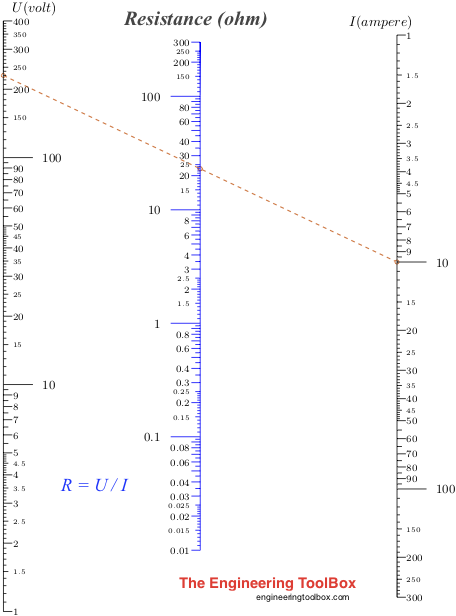 Download and print the Electric Resistance vs. volt and ampere nomogram!
The default values in the nomogram above indicates 230 volts , resistance 24 ohm and current 10 amps .
Power dissipated Resistors
Electric power in resistor circuit can be expressed as
P = U I
= R I2
= U2/ R (4)
where
P = electrical power (watts, W)
Example - Power Consumed
The power consumed or dissipated in the 18 ohm resistor in the 12V electrical circuit above can be calculated as
P = (12 volts)2/ (18 ohm)
= 8 W
Example - Power and Electrical Resistance
A 100 W electric light bulb is connected to a 230 V supply. The current flowing can be calculated by reorganizing (4) to
I = P / U
= (100 W) / (230 V)
= 0.43 ampere
The resistance can be calculated by reorganizing (4) to
R = U2/ P
= (230 V)2/ (100 W)
= 529 Ω
Electric Power Nomogram
This nomogram can be used to estimate power vs. voltage and ampere.
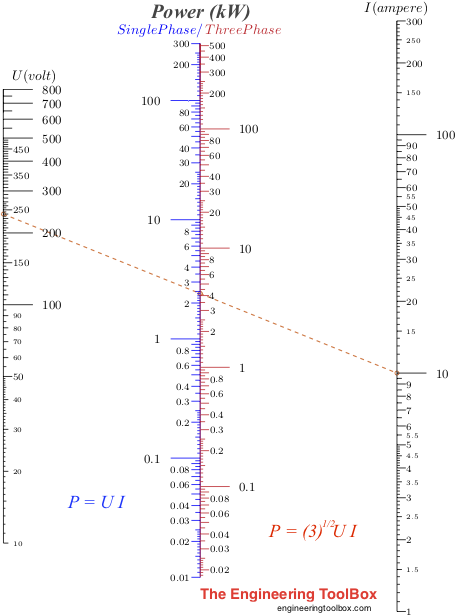 Download and print the Electric Power vs. volt and ampere nomogram!
The default values in the nomogram above indicates 240 volts , resistance 10 amps and power 2.4 kW for DC or single phase AC - and 4 kW for three phase AC.
Related Topics
-
Electrical
Electrical engineering with units, amps and electrical wiring. Wire gauges, electrical formulas, motors and more.
Related Documents
-
Aluminum Conductor Characteristics
Characteristics of all-aluminum conductors (AAC). -
Copper Wire - Electrical Resistance vs. Gauge
Gauge, weight, circular mils and electrical resistance in copper wire. -
Electric Circuit Diagram - Drawing Template
Online shareable electric circuit diagram. -
Electric Circuits Voltage Drop
Ohm's law and voltage drop in electric circuits. -
Electrical Formulas
Commonly used electrical formulas like Ohms Law and more. -
Electrical Parallel Circuits
Resistance, voltage and current in electrical parallel circuits. -
Electrical Series Circuits
Voltage and current in electrical series circuits. -
Electrical Units
Definition of common electrical units - like Ampere, Volt, Ohm, Siemens. -
EV - Electric Vehicles Range vs. State of Charge (SOC) Calculator
Electric vehicle range vs. battery size, SOC - state of charge and energy consumption. -
Nickel-Chromium Heater Wire - Temperature Rise vs. Amps
Electric resistance vs. temperature rise for Nickel-Chromium electrical heater wire. -
Resistance vs. Conductance
The reciprocal of electrical resistance is conductance. -
Resistivity and Conductivity - Temperature Coefficients Common Materials
Resistivity, conductivity and temperature coefficients for common materials like silver, gold, platinum, iron and more.. -
Resistors - Color Codes Calculator
Color codes for fixed resistors - values and tolerances - online calculator. -
Resistors - Standard Values
Preferred number series for resistors.



