
Pipes Submerged in Water - Heat Emission
Heat emision from steam or water heating pipes submerged in water - assisted (forced) or natural circulation.
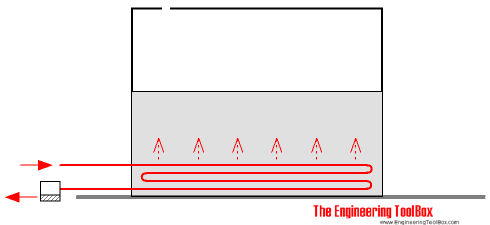
Heat emission from steam or water pipes or tubes submerged in water:
| Temperature Difference between the Steam/Water in the Pipe and the Surrounding Water | Heat Transfer Rate to the Surrounding Water | ||
|---|---|---|---|
| (oF) | (oC) | (Btu/(ft2 h oF)) | (W/(m2 oC)) |
| 50 | 28 | 100 - 225 | 570 - 1280 |
| 100 | 56 | 175 - 300 | 1000 - 1700 |
| 200 | 111 | 225 - 475 | 1300 - 2700 |
Note that with a higher temperature difference there is a more vigorous movement on the water side and the heat transfer rate goes up. Forced or assisted circulation on the water side also results in higher heat transfer rates as indicated below.
For practical applications - the heat transfer rates can roughly be set to:
| Type of Application | Heat Transfer Rate to the Surrounding Water | |
|---|---|---|
| (Btu/(ft2 h oF)) | (W/(m2 oC)) | |
| Tank coils with low pressure steam, natural circulation in the tank | 100 | 570 |
| Tank coils with high pressure steam, natural circulation in the tank | 200 | 1100 |
| Tank coils with low pressure steam, forced circulation in the tank | 200 | 1100 |
| Tank coils with high pressure steam, forced circulation in the tank | 300 | 1700 |
- Dimensions of Carbon, Alloy and Stainless Steel Pipes - ASME/ANSI B36.10/19
- Outside surface area - pipe equations
Example - Steam Coil in Water
A DN25 (1") Std steam coil of one meter is submerged in water with temperature 20 oC. The steam pressure is aprox. 1 bar with a steam temperature aprox. 120 oC.
The area of the submerged coil can be calculated as:
A = (1 m) 2 π (0.0334 m) / 2
= 0.10 m2
With low pressure steam and non-assisted circulation we presume from the table above that the heat transfer rate is 570 W/m2oC.
Heat transfer from steam to water can then be calculated:
Q = (570 W/(m2oC)) (0.10 m2) (120oC - 20oC)
= 5700 W
= 5.7 kW
Related Topics
-
Heating Systems
Design of heating systems - capacities and design of boilers, pipelines, heat exchangers, expansion systems and more. -
Insulation and Heat Loss from Steam and Condesate Pipe Lines
Heat loss from uninsulated and insulated steam and condensate pipes and tanks. Calculate insulation thicknesses. -
Steam and Condensate
Design of steam & condensate systems with properties, capacities, sizing of pipe lines, system configuration and more.
Related Documents
-
Condensation of Steam - Heat Transfer
Heat transfer when steam condensates. -
Copper Tubes - Heat Losses
Heat loss from uninsulated copper tubes vs. temperature differences between tube and air. -
Copper Tubes - Uninsulated Heat Losses
Heat loss from uninsulated copper pipes - dimensions ranging 1/2 - 4 inches. -
Greenhouse Pipes - Heat Emission
Heat emission from steam and hot water pipes typical used in greenhouse installations. -
Heat Loss from Oil Filled Tanks and Pipe Lines
Heat loss from insulated and non insulated sheltered and exposed oil tanks and pipes. -
Heat Loss from Open Water Tanks
Due to evaporation the heat loss from an open water tank like a swimming pool may be considerable. -
Heating Water by Injecting Steam
Water can be heated by injecting steam. -
Oil Filled Tanks - Heat Loss
Heat loss from insulated and uninsulated, sheltered and exposed heated oil tanks. -
Oil Tanks - Heat Loss
Heat loss from lagged and unlagged, sheltered and exposed oil tanks. -
Pipes - Bare Surface Heat Loss
Heat loss vs. surface temperature. -
Pipes and Cylinders - Conductive Heat Losses
Conductive heat losses through cylinder or pipe walls. -
Pipes Submerged in Oil or Fat - Heat Emission
Heat emission from steam or water heating pipes submerged in oil or fat - forced and natural circulation. -
Steam Pipes - Heat Losses
The amount of condensate generated in a steam pipe depends on the heat loss from the pipe to the surroundings. -
Steam Pipes - Heat Losses (W/m)
Heat losses from un-insulated steam pipes. -
Steel Pipes - Heat Loss Diagram
Heat loss from steel pipes and tubes - dimensions 1/2 to 12 inches. -
Submerged Coils - Heat Transfer Coefficients
Heat transfer coefficients for steam and hot water coils submerged in oil tanks.



