
Fluid Flow - Equivalent Diameter
Convert rectangular and oval duct geometry to a equivalent circular diameter - online calculator with imperial and SI-units.
The equivalent diameter is the diameter of a circular duct or pipe that for equal flow gives the same pressure loss or resistance as an equivalent rectangular duct or pipe. A round shape results in lower pressure drops and less fan horsepower to move the air and, consequently, smaller equipment.
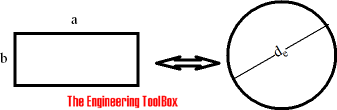
The equivalent diameter of a rectangular tube or duct can be calculated as (Huebscher)
de = 1.30 (a b)0.625 / (a + b)0.25 (1)
where
de = equivalent diameter (mm, inches)
a= length of major or minor side (mm, inches)
b= length of minor or major side (mm, inches)
- Hydraulic diameter - the "characteristic length" used to calculate the dimensionless Reynolds Number
Example - Equivalent Diameter
The equivalent diameter of a 300 mm x 500 mm rectangular duct can be calculated as
de = 1.30 ((300 mm) (500 mm))0.625 / ((300 mm) + (500 mm))0.25
= 420 mm
Rectangular to Equivalent Circular Duct Calculator
The calculator below is based on formula (1). The formula is generic and any unit can be used.
Equivalent diameters for some common mm rectangular duct dimensions:
For full table with larger dimensions - rotate the screen!
| Circular equivalent diameter - de (mm) | |||||||||||||||
|---|---|---|---|---|---|---|---|---|---|---|---|---|---|---|---|
| Duct side - a - (mm) | Duct side - b (mm) | ||||||||||||||
| 100 | 150 | 200 | 250 | 300 | 400 | 500 | 600 | 800 | 1000 | 1200 | 1400 | 1600 | 1800 | 2000 | |
| 100 | 109 | 133 | 152 | 168 | 183 | 207 | 227 | ||||||||
| 150 | 133 | 164 | 189 | 210 | 229 | 261 | 287 | 310 | |||||||
| 200 | 152 | 189 | 219 | 244 | 266 | 305 | 337 | 365 | |||||||
| 250 | 168 | 210 | 246 | 273 | 299 | 343 | 381 | 414 | 470 | ||||||
| 300 | 183 | 229 | 266 | 299 | 328 | 378 | 420 | 457 | 520 | 574 | |||||
| 400 | 207 | 260 | 305 | 343 | 378 | 437 | 488 | 531 | 609 | 674 | 731 | ||||
| 500 | 227 | 287 | 337 | 381 | 420 | 488 | 547 | 598 | 687 | 762 | 827 | 886 | |||
| 600 | 310 | 365 | 414 | 457 | 531 | 598 | 656 | 755 | 840 | 914 | 980 | 1041 | |||
| 800 | 414 | 470 | 520 | 609 | 687 | 755 | 875 | 976 | 1066 | 1146 | 1219 | 1286 | |||
| 1000 | 517 | 574 | 674 | 762 | 840 | 976 | 1093 | 1196 | 1289 | 1373 | 1451 | 1523 | |||
| 1200 | 620 | 731 | 827 | 914 | 1066 | 1196 | 1312 | 1416 | 1511 | 1598 | 1680 | ||||
| 1400 | 781 | 886 | 980 | 1146 | 1289 | 1416 | 1530 | 1635 | 1732 | 1822 | |||||
| 1600 | 939 | 1041 | 1219 | 1373 | 1511 | 1635 | 1749 | 1854 | 1952 | ||||||
| 1800 | 1096 | 1286 | 1451 | 1598 | 1732 | 1854 | 1968 | 2073 | |||||||
| 2000 | 1523 | 1680 | 1822 | 1952 | 2073 | 2186 | |||||||||
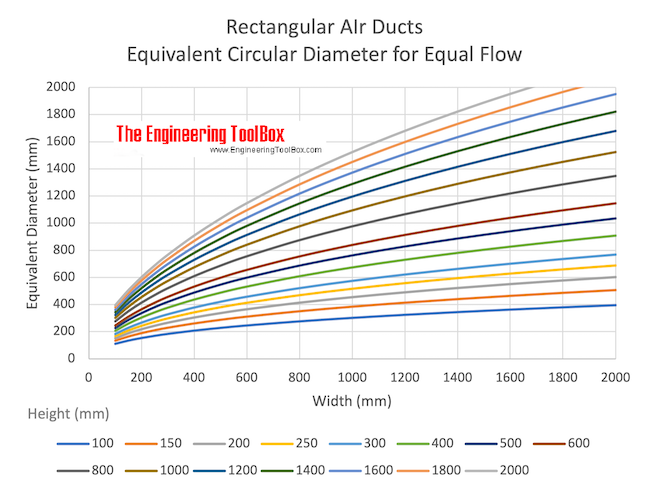
print equivalent diameter diagram!
Equivalent diameters of some common inches rectangular ducts:
For full table - rotate the screen!
| Circular equivalent diameter (inches) | |||||||
|---|---|---|---|---|---|---|---|
| Length - b - (inches) | Length - a - (inches) | ||||||
| 4 | 5 | 6 | 8 | 10 | 12 | 16 | |
| 4 | 4.4 | 4.9 | 5.3 | 6.1 | |||
| 5 | 4.9 | 5.5 | 6 | 6.9 | 7.6 | ||
| 6 | 5.3 | 6 | 6.6 | 7.6 | 8.4 | 9.1 | |
| 8 | 6.1 | 6.9 | 7.6 | 8.6 | 9.8 | 10.7 | 12.2 |
| 10 | 7.6 | 8.4 | 9.8 | 10.9 | 12 | 13.7 | |
| 12 | 9.1 | 10.7 | 12 | 13.1 | 15.1 | ||
| 16 | 12.2 | 13.7 | 15.1 | 17.5 | |||
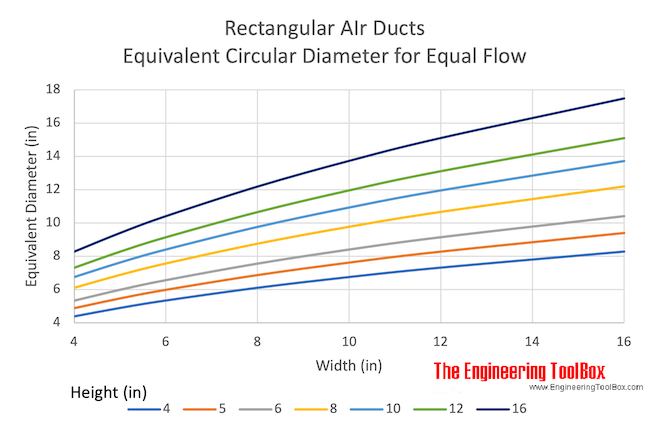
print equivalent diameter diagram!
Oval Equivalent Diameter (Ellipse)
Flat oval ducts have smaller height requirements than round ducts and retain most of the advantages of the round ducts. Fittings for flat oval ducts are difficult to fabricate or modify in the field.
The equivalent diameter of a oval duct or tube (ellipse) can be calculated as (Heyt & Diaz)
de = 1.55 A0.625 / P0.25 (2)
where
A = cross-sectional area oval duct (m2, in2)
P = perimeter oval duct (m, inches)

The cross-sectional area of an oval duct can be expressed as
A = π a b / 4
where
a = major dimension of the flat oval duct (m, in)
b = minor dimension of the flat oval duct (m, in)
The perimeter of an oval duct (ellipse) can be approximated to
P ≈ 2 π (1/2 ((a / 2)2 + (b / 2)2))1/2 (2b)
Oblong Ducts
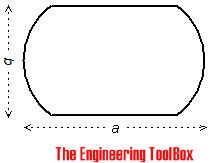
Equivalent diameters of oblong ducts or pipes can be expressed as
de = 1.55 (π b2 / 4 + a b - b2)0.625/(π b + 2 a - 2 b)0.25 (3)
Hydraulic Diameter
Note! - equivalent diameter is not the same as hydraulic diameter. The hydraulic diameter express the rate between the area section of the duct or tube, and the wetted perimeter of the duct or tube. Hydraulic diameter is used to determine if the flow is laminar or turbulent and to calculate the pressure loss.
Related Topics
-
Fluid Mechanics
The study of fluids - liquids and gases. Involving velocity, pressure, density and temperature as functions of space and time. -
Ventilation Systems
Design of systems for ventilation and air handling - air change rates, ducts and pressure drops, charts and diagrams and more.
Related Documents
-
Air Ducts - Friction Loss Diagram
A major friction loss diagram for air ducts - Imperial units ranging 10 - 100 000 cfm. -
Air Ducts - Major Friction Head Loss, Online Calculator
Head loss or major loss in air ducts - equations and online calculator for rectangular and circular ducts - Imperial and SI units. -
Ducts - Cross-Sectional Area vs. Diameter
Circular ducts sross-sectional areas. -
Equivalent Diameter - Rectangular vs. Circular HVAC Ducts
Rectangular equivalent diameter for air flows between 100 - 50000 cfm. -
Equivalent Length Method - Minor Pressure Loss in Piping Systems
Calculate minor pressure loss in piping systems with the Equivalent Pipe Length Method. -
Fluid Flow - Hydraulic Diameter
Calculate hydraulic diameter for pipes and ducts. -
Fuel Oil Storage Tanks
Fuel oil storage tanks dimensions. -
Rectangular Ducts - Dimensions
Commonly used metric dimensions for rectangular air ducts in ventilation systems. -
Rectangular Ducts - Hydraulic Diameter
Calculate hydraulic diameter for rectangular ducts - metric units. -
Smaller Rectangles within a Larger Rectangle
The maximum number of smaller rectangles - or squares - within a larger rectangle (or square).



