
Electrical Conductivity - Elements and other Materials
Electric conductance is the ability of a element to conduct an electric current.
- Conductors are materials with loosely attached valence electrons - electrons can drift freely between the atoms
- Insulators have structures where the electrons are bound to the atoms by ionic or covalent bonds - almost no current can flow
- Semiconductors are insulating materials where the bonds can be broken with applied voltage - electrons can be released and moved from one vacated valence site to another.
Electrical Conductivity
Electrical conductivity or specific conductivity is the measure of a material's ability to conduct electric current. Conductivity is the reciprocal (inverse) of electrical resistivity .
Electrical conductivity is defined as the ratio of the current density to the electric field strength and can be expressed as
σ = J / E (1)
where
σ = electrical conductivity (1/ohms m, 1/ Ω m, siemens/m, S/m, mho/m)
J = current density (amps/m2)
E = electric field strength (volts/m)
One siemens - S - is equal to the reciprocal of one ohm and is also referred to as one mho.
Electrical Conductivity of some Common Materials
| Product | Electrical Conductivity - σ - (1/Ω m, S/m, mho/m) |
|---|---|
| Aluminum | 37.7 106 |
| Beryllium | 31.3 106 |
| Cadmium | 13.8 106 |
| Calcium | 29.8 106 |
| Chromium | 7.74 106 |
| Cobalt | 17.2 106 |
| Copper | 59.6 106 |
| Copper - annealed | 58.0 106 |
| Gallium | 6.78 106 |
| Gold | 45.2 106 |
| Iridium | 19.7 106 |
| Iron | 9.93 106 |
| Indium | 11.6 106 |
| Lithium | 10.8 106 |
| Magnesium | 22.6 106 |
| Molybdenum | 18.7 106 |
| Nickel | 14.3 106 |
| Niobium | 6.93 106 |
| Osmium | 10.9 106 |
| Palladium | 9.5 106 |
| Platinum | 9.66 106 |
| Potassium | 13.9 106 |
| Rhenium | 5.42 106 |
| Rhodium | 21.1 106 |
| Rubidium | 7.79 106 |
| Ruthenium | 13.7 106 |
| Silver | 63 106 |
| Sodium | 21 106 |
| Strontium | 7.62 106 |
| Tantalum | 7.61 106 |
| Technetium | 6.7 106 |
| Thallium | 6.17 106 |
| Thorium | 6.53 106 |
| Tin | 9.17 106 |
| Tungsten | 18.9 106 |
| Zinc | 16.6 106 |
| Seawater | 4.5 - 5.5 |
| Water - Drinking | 0.0005 - 0.05 |
| Water - Deionized | 5.5 10-6 |
- 1 S/m = 104 μS/cm = mho/m
- 1 S/cm = 10-2 S/m
- 1 1/Ω m = S/m = 3.28 1/Ω ft = 3.28 S/ft
Electrical Conductivity of Elements relative to Silver
| Element | Electrical Conductivity relative to Silver |
|---|---|
| Silver | 100.0 |
| Copper | 94.6 |
| Gold | 71.7 |
| Aluminum | 59.8 |
| Beryllium | 49.7 |
| Calcium | 47.3 |
| Magnesium | 35.9 |
| Rhodium | 33.5 |
| Sodium | 33.0 |
| Barium | 30.6 |
| Tungsten | 30.0 |
| Molybdenum | 29.7 |
| Cobalt | 27.3 |
| Zinc | 26.3 |
| Nickel | 22.6 |
| Cadmium | 21.9 |
| Ruthenium | 21.7 |
| Cesium | 20.0 |
| Indium | 18.4 |
| Osmium | 17.3 |
| Lithium | 17.1 |
| Uranium | 16.5 |
| Manganese | 15.8 |
| Iron | 15.8 |
| Platinum | 15.3 |
| Palladium | 15.1 |
| Tin | 14.6 |
| Titanium | 13.7 |
| Iridium | 13.5 |
| Rubidium | 12.4 |
| Chromium | 12.3 |
| Tantalum | 12.1 |
| Steel | 12.0 |
| Thallium | 9.8 |
| Lead | 8.4 |
| Columbium | 5.1 |
| Vanadium | 5.0 |
| Arsenic | 4.9 |
| Antimony | 3.6 |
| Mercury | 1.8 |
| Bismuth | 1.4 |
| Tellurium | 0.0 |
Electrical Conductivity of Highly Purified Water

Electrical Resistivity
Conductivity is the reciprocal (inverse) of electrical resistivity. Electrical resistivity can be expressed as
ρ = 1 / σ (2)
where
ρ = electrical resistivity (ohm m2/m, ohm m)
Resistance of a Conductor
The resistance for a conductor can be expressed as
R = ρ l / A (3)
where
R = resistance (ohms, Ω)
l = length of conductor (m)
A = cross sectional area of conductor (m2)
Example - Resistance of a Wire
The resistance of 1000 m copper wire gauge #10 with cross sectional area 5.26 mm2 can be calculated as
R = (1.724 x 10 -8 ohm m2/m) (1000 m) / (( 5.26 mm2) (10-6 m2/mm2))
= 3.2 ohm
Resistivity and Conductivity Conversion
| Grains/gal as CaCO3 | ppm as CaCO3 | ppm NaCl | Conductivity μmho/cm | Resistivity MΩ/cm |
|---|---|---|---|---|
| 99.3 | 1700 | 2000 | 3860 | 0.00026 |
| 74.5 | 1275 | 1500 | 2930 | 0.00034 |
| 49.6 | 850 | 1000 | 1990 | 0.00050 |
| 24.8 | 425 | 500 | 1020 | 0.00099 |
| 9.93 | 170 | 200 | 415 | 0.0024 |
| 7.45 | 127 | 150 | 315 | 0.0032 |
| 4.96 | 85.0 | 100 | 210 | 0.0048 |
| 2.48 | 42.5 | 50 | 105 | 0.0095 |
| 0.992 | 17.0 | 20 | 42.7 | 0.023 |
| 0.742 | 12.7 | 15 | 32.1 | 0.031 |
| 0.496 | 8.50 | 10 | 21.4 | 0.047 |
| 0.248 | 4.25 | 5.0 | 10.8 | 0.093 |
| 0.099 | 1.70 | 2.0 | 4.35 | 0.23 |
| 0.074 | 1.27 | 1.5 | 3.28 | 0.30 |
| 0.048 | 0.85 | 1.00 | 2.21 | 0.45 |
| 0.025 | 0.42 | 0.50 | 1.13 | 0.88 |
| 0.0099 | 0.17 | 0.20 | 0.49 | 2.05 |
| 0.0076 | 0.13 | 0.15 | 0.38 | 2.65 |
| 0.0050 | 0.085 | 0.10 | 0.27 | 3.70 |
| 0.0025 | 0.042 | 0.05 | 0.16 | 6.15 |
| 0.00099 | 0.017 | 0.02 | 0.098 | 10.2 |
| 0.00070 | 0.012 | 0.015 | 0.087 | 11.5 |
| 0.00047 | 0.008 | 0.010 | 0.076 | 13.1 |
| 0.00023 | 0.004 | 0.005 | 0.066 | 15.2 |
| 0.00012 | 0.002 | 0.002 | 0.059 | 16.9 |
- grains/gal = 17.1 ppm CaCO3
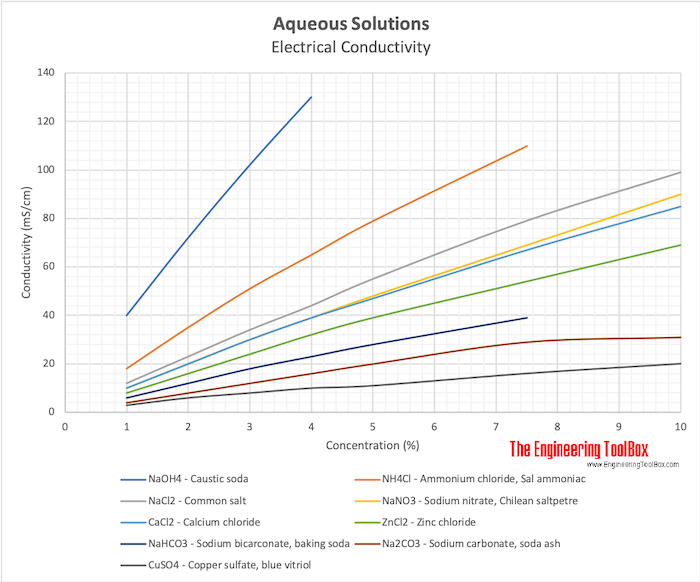
Electrical Conductivity of Aqueous Solutions
Electrical conductivity of aqueous solutions like
- NaOH 4 - Caustic soda
- NH 4 Cl - Ammonium chloride, Sal ammoniac
- NaCl2- Common salt
- NaNO3 - Sodium nitrate, Chilean saltpetre
- CaCl2- Calcium chloride
- ZnCl2- Zinc chloride
- NaHCO3 - Sodium bicarconate, baking soda
- Na2CO3 - Sodium carbonate, soda ash
- CuSO 4 - Copper sulfate, blue vitriol
Related Topics
-
Electrical
Electrical engineering with units, amps and electrical wiring. Wire gauges, electrical formulas, motors and more.
Related Documents
-
Aluminum and Copper Wires - Electrical Resistance vs. Cross-Sectional Area
Electrical resistance in plain copper or aluminum wires. -
AWG - American Wire Gauge Converting Chart
American Wire Gauge (AWG) vs. cross sectional area converter. -
Capacitors
Capacitors and capacitance - charge and unit of charge. -
Capacitors - Parallel and Serial Circuits
Parallel and serial connected capacitor circuits. -
Copper Wire - Electrical Resistance vs. Gauge
Gauge, weight, circular mils and electrical resistance in copper wire. -
Dielectric Strength of Insulating Materials
The dielectric strength of a material is the ability to the material to act as an insulator. -
Electric Wire - Resistance
Electric resistance in wire made of Copper, Aluminum, Brass, Constantan, Nichrome, Platinum, Silver or Tungsten. -
Electrical Parallel Circuits
Resistance, voltage and current in electrical parallel circuits. -
Elements - Boiling Points
Elements and their boiling points. -
Resistance vs. Resistivity
Electrical resistance and resistivity. -
Resistivity and Conductivity - Temperature Coefficients Common Materials
Resistivity, conductivity and temperature coefficients for common materials like silver, gold, platinum, iron and more.. -
Voltage Dividers - Online Calculator
Output voltage potential divider. -
Voltage Sources vs. Current Sources
Voltage and Current Sources



