
Insulated Steam Pipes - Condensate Generated (kg/h per 100m)
Heat loss from steam pipes generates condensate which must be drained from the system.
The diagram and table below can be used to indicate condensate generated due to heat loss in insulated steam pipes.
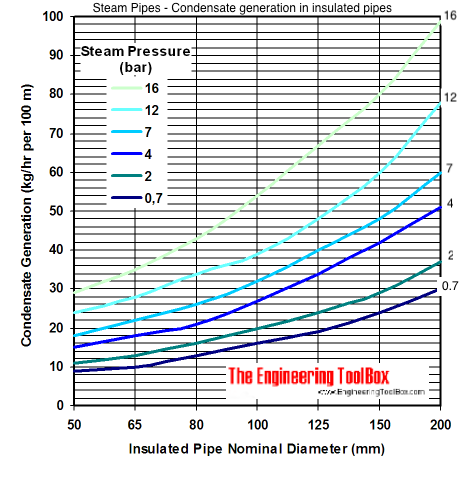
| Steam Pressure (bar) | Condensate Generation (kg/h per 100 m) | ||||||||
|---|---|---|---|---|---|---|---|---|---|
| Pipe Size (mm) | |||||||||
| 50 | 65 | 80 | 100 | 125 | 150 | 200 | 250 | 300 | |
| 0.7 | 9 | 10 | 13 | 16 | 19 | 24 | 30 | 36 | 44 |
| 2 | 11 | 13 | 16 | 20 | 24 | 29 | 37 | 46 | 55 |
| 4 | 15 | 18 | 21 | 28 | 37 | 42 | 51 | 63 | 75 |
| 7 | 18 | 22 | 26 | 32 | 41 | 48 | 60 | 75 | 89 |
| 12 | 24 | 28 | 34 | 39 | 49 | 57 | 79 | 99 | 117 |
| 16 | 29 | 35 | 43 | 54 | 67 | 80 | 99 | 123 | 147 |
| 20 | 31 | 38 | 46 | 57 | 71 | 83 | 105 | 131 | 155 |
| 28 | 34 | 41 | 50 | 63 | 78 | 92 | 117 | 145 | 173 |
| 35 | 41 | 50 | 59 | 74 | 92 | 110 | 137 | 172 | 204 |
| 42 | 45 | 59 | 66 | 83 | 103 | 124 | 155 | 193 | 229 |
- 1 inch = 25.4 mm
The table is based on a surrounding temperature of 20 oC and 80% insulation efficiency compared with uninsulated pipes.
At a surrounding temperature -20 oC approximately 50% condensate load should be added.
Related Topics
-
Insulation and Heat Loss from Steam and Condesate Pipe Lines
Heat loss from uninsulated and insulated steam and condensate pipes and tanks. Calculate insulation thicknesses. -
Steam and Condensate
Design of steam & condensate systems with properties, capacities, sizing of pipe lines, system configuration and more.
Related Documents
-
Condensate Generated in Cold Steam Pipes - SI Units
Huge amounts of condensate are generated when cold steam pipes are heated up must be drained from the pipes. -
Condensate Generated in Cold Steam Pipes - Sizing of Steam Traps
When cold steam pipes are heated up they generate huge amounts of condensate that must be drained away from the pipe through steam traps - in Imperial Units. -
Condensate Pipe Lines - Friction Resistance Imperial Units
Friction or major resistance in condensate pipe lines. -
Condensate Pipe Lines - Sizing
Flow and pressure loss in condensate return lines - SI Units. -
Condensate Pipes - Flash Steam Generated
Calculate flash steam generation in condensate pipe lines. -
Condensate Pumping
High temperatures and danger of impeller cavitation is the major challenge for condensate pumping in steam systems. -
Insulated Steam Pipes - Condensate Generated
Heat loss from steam pipes generates condensate which must be drained from the system - imperial units. -
Pipes and Equipment - Identification Labels
Tags and label colors used for mechanical, plumbing and piping systems. -
Steam - Condensate Pipe Lines - Capacities (kW)
Maximum capacities for condensate pipe lines in kW steam consumption. -
Steam - Gravity Return Condensate Pipes - Capacities
Max. capacities (lb/hour) in gravity condensate return lines. -
Steam Pipes - Installation of Drip Legs
Properly draining steam pipes for condensate. -
Steam Pipes - Sizing
Sizing of steam pipe lines - major and minor loss in steam distribution systems. -
Steam Trap Selection Guide
Steam trap selection guide - Float & Thermostatic, Inverted Bucket, Bimetal Thermostatic, Impulse and Thermodynamic Disc steam traps. -
Steam Traps - Safety Factors
Selection of steam traps and their safety factors.



