
Colebrook Equation
Friction loss coefficients in pipes, tubes and ducts.
The friction coefficients used when calculating resistance or pressure loss (or major loss) in ducts, tubes or pipes can be calculated with the Colebrook equation
1 / λ1/2= -2 log [ 2.51 / (Re λ1/2) + (k / dh) / 3.72 ] (1)
where
λ = Darcy-Weisbach friction coefficient
Re = Reynolds Number
k = roughness of duct, pipe or tube surface (m, ft)
dh= hydraulic diameter (m, ft)
The Colebrook equation is only valid at turbulent flow conditions .
Note! - the friction coefficient is involved on both sides of the equation. The equation must therefore be solved by iteration.
The Colebrook equation is generic and can be used to calculate friction coefficients for different kinds of fluid flows - like air ventilation ducts, pipes and tubes with water or oil, compressed air and much more.
Colebrook Online Calculator
The friction coefficient can be calculated with the online Colebrook calculator below.
The default values used are for turbulent air flow in a 315 mm duct with 6 m/s (0.47 m3/s) . The kinematic viscosity used to calculate the Reynolds Number is 15 10-6 m2/s .
Replace the parameters with the appropriate values for your application.
The calculator below can be used to calculate the friction coefficient if velocity and kinematic viscosity of the fluid are known.
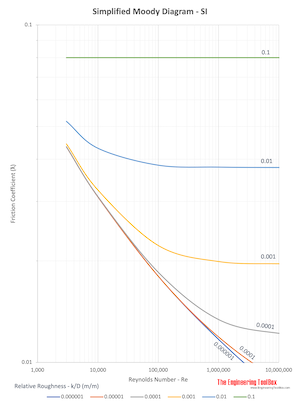
The friction coefficient can also be estimated with the Moody diagram (SI based):
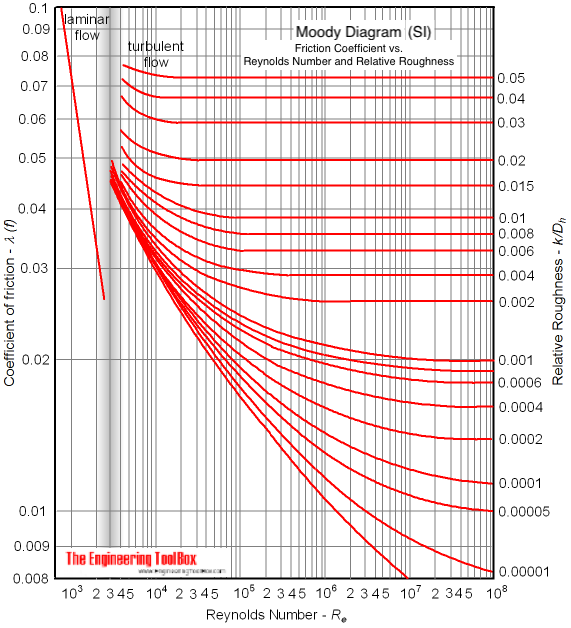
Download and print Moody Diagram
Simplified Moody Diagram - SI
Related Topics
-
Fluid Mechanics
The study of fluids - liquids and gases. Involving velocity, pressure, density and temperature as functions of space and time. -
Ventilation Systems
Design of systems for ventilation and air handling - air change rates, ducts and pressure drops, charts and diagrams and more.
Related Documents
-
Darcy-Weisbach Equation - Major Pressure and Head Loss due to Friction
The Darcy-Weisbach equation can be used to calculate the major pressure and head loss due to friction in ducts, pipes or tubes. -
Duct Velocity
Calculate velocities in circular and rectangular ducts - imperial and SI-units - online calculator. -
Energy Equation - Pressure Loss vs. Head Loss
Calculate pressure loss - or head loss - in ducts, pipes or tubes. -
Fluid Flow - Hydraulic Diameter
Calculate hydraulic diameter for pipes and ducts. -
Laminar Flow - Friction Coefficients
Calculate friction coefficients for laminar fluid flow. -
Moody Diagram
Calculate fluid flow friction coefficients from a Moody diagram. -
Natural Draft - Air Flow Volume and Velocity
Air flow - volume and velocity - due to stack or flue effect caused by indoor hot and outdoor cold temperature difference. -
Reynolds Number
Introduction and definition of the dimensionless Reynolds Number - online calculators. -
Roughness & Surface Coefficients
Surface coefficients that can be used to calculate friction and major pressure loss for fluid flow with surfaces like concrete, galvanized steel, corroded steel and more.



