
Pumps - Classifications
Centrifugal pumps vs. positive displacement pumps.
Pumps are in general classified as Centrifugal Pumps (or Roto-dynamic pumps) and Positive Displacement Pumps.
Centrifugal Pumps (Roto-dynamic pumps)
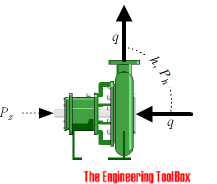
The centrifugal or roto-dynamic pump produce a head and a flow by increasing the velocity of the liquid through the machine with the help of the rotating vane impeller. Centrifugal pumps include radial, axial and mixed flow units.
Centrifugal pumps can be classified further as
- end suction pumps
- in-line pumps
- double suction pumps
- vertical multistage pumps
- horizontal multistage pumps
- submersible pumps
- self-priming pumps
- axial-flow pumps
- regenerative pumps
Positive Displacement Pumps
A positive displacement pump operates by alternating filling a cavity and then displacing a given volume of liquid. A positive displacement pump delivers a constant volume of liquid for each cycle independent of discharge pressure or head.
The positive displacement pump can be classified as:
- Reciprocating pumps - piston, plunger and diaphragm
- Power pumps
- Steam pumps
- Rotary pumps - gear, lobe, screw, vane, regenerative (peripheral) and progressive cavity
Selecting between Centrifugal or Positive Displacement Pumps
Selecting between a Centrifugal Pump or a Positive Displacement Pump is not always straight forward.
Flow Rate and Pressure Head
The two types of pumps behave very differently regarding pressure head and flow rate:
- The Centrifugal Pump has varying flow depending on the system pressure or head
- The Positive Displacement Pump has more or less a constant flow regardless of the system pressure or head. Positive Displacement pumps generally makes more pressure than Centrifugal Pump's.
Capacity and Viscosity
Another major difference between the pump types is the effect of viscosity on capacity:
- In a Centrifugal Pump the flow is reduced when the viscosity is increased
- In a Positive Displacement Pump the flow is increased when viscosity is increased
Liquids with high viscosity fills the clearances of Positive Displacement Pumps causing higher volumetric efficiencies and Positive Displacement Pumps are better suited for higher viscosity applications. A Centrifugal Pump becomes very inefficient at even modest viscosity.
Mechanical Efficiency
The pumps behaves different considering mechanical efficiency as well.
- Changing the system pressure or head has little or no effect on the flow rate in a Positive Displacement Pump
- Changing the system pressure or head may have a dramatic effect on the flow rate in a Centrifugal Pump
Net Positive Suction Head - NPSH
Another consideration is the Net Positive Suction Head - NPSH.
- In a Centrifugal Pump, NPSH varies as a function of flow determined by pressure
- In a Positive Displacement Pump, NPSH varies as a function of flow determined by speed. Reducing the speed of the Positive Displacement Pump pump, reduces the NPSH
Related Topics
-
Pumps
Design of pumping systems and pipelines. With centrifugal pumps, displacement pumps, cavitation, fluid viscosity, head and pressure, power consumption and more.
Related Documents
-
Alternating Pumps
Securing a system and achieve equal wear by alternating pumps in parallel. -
Centrifugal Pump Standards
International centrifugal pump design and dimension standards. -
Centrifugal Pumps
An introduction to Centrifugal Pumps. -
Centrifugal Pumps - Speed Torque Curve
The characteristic speed torque curves for centrifugal pumps. -
Centrifugal Pumps - Stable and Unstable Flow
The characteristics of stable and unstable flow. -
Positive Displacement Pumps
Introduction tutorial to positive displacement pumps basic operating principles. -
Pump - Temperature Rise vs. Volume Flow
Calculate temperature rise vs. volume flow in pumps. -
Pumping Water - Energy Cost Calculator
Calculate the energy cost of pumping water. -
Pumps - NPSH (Net Positive Suction Head)
An introduction to pumps and the Net Positive Suction Head (NPSH). -
Pumps vs. Compressors, Blowers and Fans
The difference between pumps, compressors, blowers and fans.



