
Chimney Sizing
Calculate chimney draft and required chimney area - online calculator.
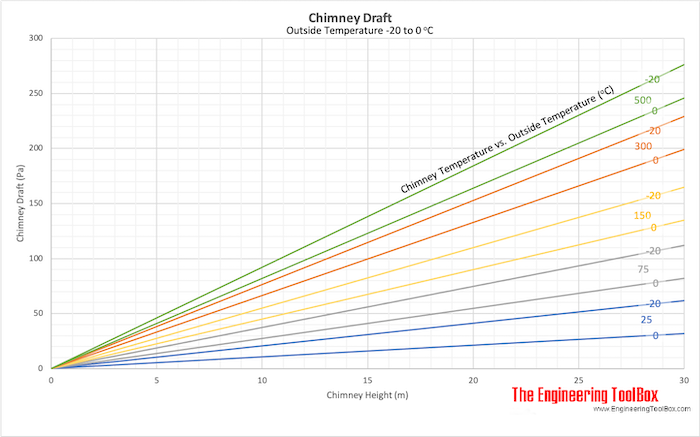
The capacity of a chimney depends on the potential chimney draft - the pressure difference created by the inside and outside air temperature difference and chimney height - and the chimney area.
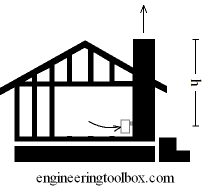
The pressure difference in the chimney pulls air and fuel gas from the boiler or fireplace through the chimney and out of the building.
Chimney Draft
The pressure difference or chimney draft can be expressed as:
dp ch = h (ρ o - ρ i ) a g (1)
where
dp ch = pressure draft in the chimney (Pa)
h = height of chimney (m)
ρ o = ambient outside density of air (kg/m3 )
ρ i = inside chimney density of air (kg/m3 )
a g = acceleration of gravity (9.81 m/s2)
Since the Ideal Gas Law states that
ρ o T o = ρ i T i
or
ρ i = ρ o T o / T i (2)
where
T = t + 273 = absolute temperature (K)
where
t = temperature (°C)
- (1) can alternatively be expressed as:
dp ch = h ( ρ o < - ρ o T o / T i ) a g
or
dp ch = h ρ o ( 1 - T o / T i ) a g (3)
Example - Chimney Draft
A 20 m high chimney operates with flue gas temperature 200 °C (473 K) . The outside temperature is 0 °C (273 K) . The density of the outside air is 1.292 kg/m3.
The draft in the chimney can be calculated with (3) as
dp ch = (20 m) (1.292 kg/m3 ) ( 1 - (273 K) / (473 K) ) (9.81 m/s2)
<
= 107 Pa
Chimney Draft Calculator
Chimney Draft Chart
Chimney Area
The velocity of air and flue gas in a smaller furnace should not exceed 2 m/s . Design velocities of larger furnaces should not exceed 10 m/s .
Required chimney area can be calculated as
A = Q / v (3)
where
A = cross-sectional area of chimney (m2)
Q = volume of flue gases at chimney temperature (m3 /s)
v = velocity (m/s)
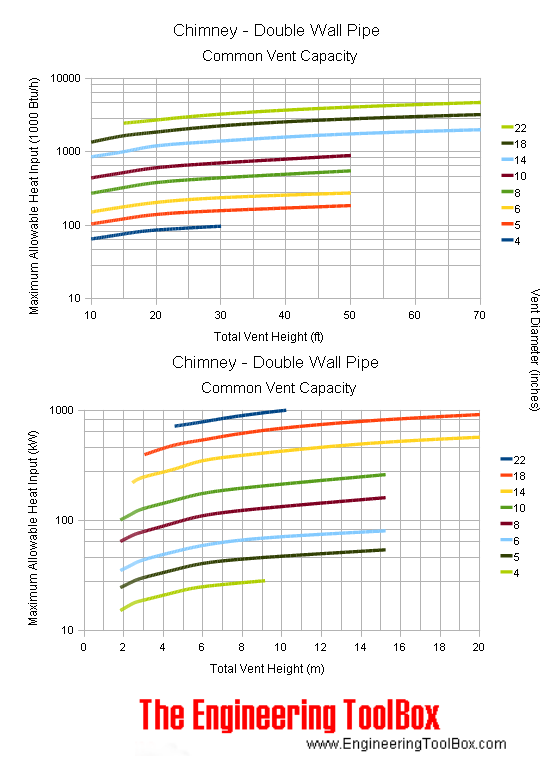
In general 1 kW boiler heat requires 1100 mm2 of chimney area.
Chimney Vent Capacity Chart - Btu/h and kW
Related Topics
-
Combustion
Combustion processes and their efficiency. Boiler house and chimney topics. Properties of fuels like oil, gas, coal and wood and more. Safety valves and tanks.
Related Documents
-
Chimney's Explosion Doors
Recommended size of explosion doors or draught stabilizers in oil fired installations. -
Chimney's Size vs. Boiler Power
The size of chimney vs. boiler's heat load. -
Chimneys - Roof Termination
Chimneys and single wall vents roof termination. -
Chimneys and Fireplace Sizing
Chimneys and fireplaces for stoves burning wood or coal as fuel. -
Natural Draft - Air Flow Volume and Velocity
Air flow - volume and velocity - due to stack or flue effect caused by indoor hot and outdoor cold temperature difference.



